Showing posts with label Fly fishing. Show all posts

Friday, May 19, 2023

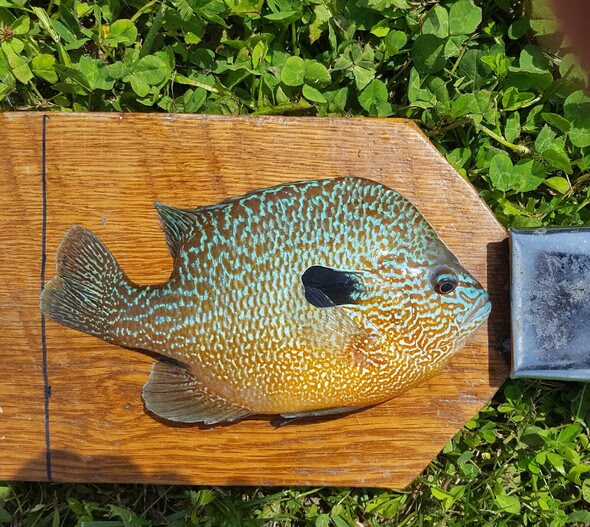
Jefferson City man ties state record for longear sunfish


John Goad says a cow may have helped him catch a 5-ounce sunfish in Crawford County.

JEFFERSON CITY, Mo. – The Missouri Department of Conservation (MDC) congratulates John Goad of Jefferson City for tying the current state record for longear sunfish. Goad was using a throwline on Frieda Lake in Crawford County May 8 when he caught the 5-ounce fish. The catch ties the previous alternative record, which was caught on a private pond in Franklin County July 3, 2021.

“I’ve been fishing this lake for around 10 years and I’ve caught crappie, bass, bluegill – all pretty good sizes,” said Goad. “But I’ve known there are good sized sunfish for about 7 or 8 years and I’ve been trying to catch a record ever since.”

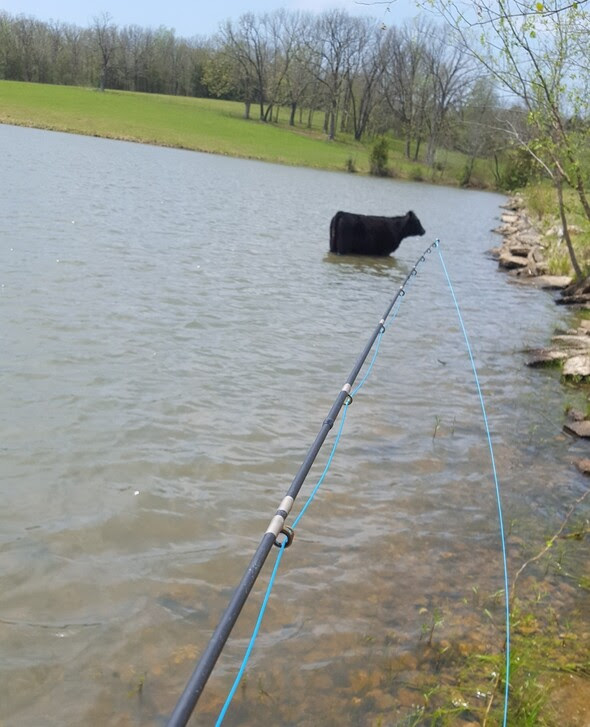
Goad fly fishes frequently, ties his own flies, and builds his own rods. He said the day started out slow as he was only catching fish every 10 casts. That was, until an unexpected visitor came to the pond.

“All the sudden, a yearling cow heifer came down to drink,” he said. “I moved down to give her space, and she crawls into the lake about belly deep. Then every cast, I caught a fish.”

Goad suspects the cow stirred up the bottom of the lake, pushing the fish in one area, and possibly helping him catch his record.

The fish was weighed on a certified MDC scale in Jefferson City. Goad said he plans to mount the sunfish.

“I was 5-years-old when I first caught a longear sunfish, so I’ve been after this for 70 years,” he laughed. “Catching a record is a really tough deal. For an old guy and a veteran, I’ve seen a lot of things, so I was excited about this record.”

Missouri state record fish are recognized in two categories: pole-and-line and alternative methods. Alternative methods include: trotline, throwline, limb line, bank line, jug line, gig, bow, crossbow, underwater spearfishing, snagging, snaring, grabbing, or atlatl. For more information on state record fish, visit http://bit.ly/2efq1vl.


Thursday, November 19, 2015

MDC stocks rainbow trout at Sedalia's Liberty Park Pond

Winter trout fishing offers anglers additional outdoor fun in urban areas
Sedalia, Mo. – Rainbow trout are once again swimming in Liberty Park Pond in Sedalia. The Missouri Department of Conservation (MDC) recently stocked 1,300 trout in the three-acre pond at Third and Park streets. Included in the stocking were 12 large, trophy-sized trout that formerly served as brood stock at the MDC Bennett Spring Fish Hatchery.
    Anglers with a valid Missouri fishing permit can fish for the trout on a catch-and-release basis through Jan. 31. All Missouri residents over age 15 and under 65 must have a valid fishing permit, and all non-residents over age 15 must have a fishing permit.
   Beginning Feb. 1, anglers with valid fishing permits and a Missouri trout permit may keep up to four trout. Only artificial lures may be used, live or scented baits are not allowed.
   MDC annually stocks rainbow trout in several urban lakes during winter to provide anglers with additional fishing opportunities. Trout need cold, clear water to survive and are not native to the Sedalia area. But ponds and small lakes are cool enough during winter to support trout. Anglers have a close-to-home chance to fish during the winter months.
   Some anglers pursue trout with fly rods using small flies and jigs as lures. Others use spinning or spincasting rods and small lures such as spinners, spoons and jigs to catch trout.
   For more information on Liberty Park Pond and a map, visit http://on.mo.gov/1RZvpvy.
   For information about rainbow trout in Missouri, visit http://mdc.mo.gov/discover-nature/field-guide/rainbow-trout.

Monday, April 20, 2015

Kids' Fishing Day scheduled for Montauk State Park

Anglers age 15 and under can fish for trout for free at May 2 event.
LICKING, Mo. – Young anglers will have opportunities to catch fish and learn about fishing at Montauk State Park’s Kids’ Fishing Day. This event will be held 6:30 a.m. to 8:15 p.m. onMay 2 at Montauk State Park. The event is sponsored by the Missouri Department of Conservation (MDC) in cooperation with the Missouri Department of Natural Resources (DNR).
At Kids’ Fishing Day, children age 15 and under can pick up their free trout tag at the registration booth from 3 p.m. to 8 p.m. on May 1 or on the day of the event. The spring branch from the CCC Spillway to the Social Hole will be reserved for the youth anglers and stocked with trout all day. Volunteers will be on hand to help out. Children are encouraged to bring their own fishing equipment. Parents are welcome to help the kids, but only one pole may be used between the helper and the child. Adults are not allowed to fish by themselves in the area designated for youth fishing.
Education is also part of Kids’ Fishing Day. Throughout the day, seminars will be held on topics related to trout fishing, fly tying, fly casting, and other topics. A Stream Table exhibit will also be on display.
There will be drawings for door prizes throughout the day. Individuals must be present to win. Free hotdogs and soda will be served from 11 a.m. to 1 p.m.
Volunteers are needed to help with this event. Individuals wishing to volunteer do not need to be experienced anglers. If you would like to volunteer or donate to Kids' Fishing Day, or want more information about the event, please call Montauk Hatchery at 573-548-2585 or contact Hatchery Manager Tom Whelan at Tom.Whelan@mdc.mo.gov

Saturday, January 21, 2012

Current River Trout Fishing Trip

My youngest son, David, and I took an excursion to the Current River last weekend before he had to get back to classes on Tuesday.  We headed out from our home about 50 miles West of St. Louis on Saturday morning and were fishing by early afternoon.

Photo taken at Baptist Camp Access of the Current River in
February of 2010.  The ice was hanging from the bluffs on our trip
beginning on January 14th of 2012, but there was much less of it.
We stopped by the Montauk State Park store to pick up a few beadhead eggs patterns and headed down to Baptist Camp.  We headed on down to Baptist Camp and got our lines wet right away.  I headed a little bit upstream and David headed downstream.  There are no great spots directly above Baptist Camp, and me not felling like going way up there, I decided to join David.

By the time I reached David he had already put a couple of stocker sized rainbows in his net and gently released them.  He caught several more before we left and I even managed to land one or two as well.

Typical Egg Pattern-
non-beaded
We used beaded egg
patterns to get deep in
the many deeper pools found
on the Current
We decided we would go down to our usual camping spot at Parker Hollow only to find it occupied.  We decided a nearly empty campground at Montauk State Park seemed like a good alternative.  We had gathered quite a bit of campwood for the fire down by Parker and it turned out to be plenty to get us through the weekend.

Saturday night was pretty chilly.  We pitched our one-man tents and built a fire to roast hot dogs before turning in for the night.  The one-man tents are nice because they are quick to set up and due to their small size, retain the body heat of the occupant.  Combined with our zero degree sleeping bags, we slept quite well.

The next morning we woke to 17 degree temperatures and a pretty steady breeze.  We knew it was supposed to warm to the fifties and the sun was out, so that made things seem a lot better.  We warmed water on the fire and ate oatmeal and then David was ready to hit the water.

I love fishing, but no one has the level of dedication to it that David does.  I took him down to the fly fishing portion of Montauk State Trout Park and turned him loose with the understanding we'd head somewhere else at noon.  I stayed in the truck until 10 am and then headed up towards where David had headed.

There is a boulder garden a little ways up the fly area and this is where he wanted to fish.  It turned out to be pretty heavily occupied so I found him fishing just down from there.

It had been a little while since we'd fished the park, and last year there were some pretty heavy floods that transformed the river in many places.  We had noticed this the previous day below Baptist Camp, where some of the holes that had held some big browns were either gone completely, or had changed quite a bit.

Anyway, at this part of the trout park, there had been a low-hanging tree just below the boulder garden riffle where I would drift a fly underneath and land a trout on almost every cast.  The tree was gone and it really made the area look different.  The fishing was still quite good.

David Mann fishing Current River
between Baptist Camp Access & Tan Vat
Access - January 2012
When I met up with David, we decided we'd kind of fish our way back to the truck, and then head back to Baptist and then fish our way up to the Tan Vat access. We caught and released quite a few fish on our way back down.

We actually got to Baptist Camp and started upstream around noon.  By this time the weather was outstanding, although a bit windy.  We stocked up on a supply of granola bars and water, grabbed our headlamps in case of an after dark return, and headed off.

One of the nice stretches of water on the
Current River between Baptist Camp
and Tan Vat - January 2012
This stretch of river is characterized by fairly long stretches of slow and shallow water broken up by some nice fishing riffles that empty into great fishing deep holes that hold some nice fish.

All the way up and as far as we got back downstream before it was too dark to fish, we stuck with egg patterns.  In reality, we could not solicit takes from the larger browns on these patterns, but the action was good enough on the smaller fish, we never switched to the nymph and streamer patterns that we typically do well on for these bigger fish.  It was just what we felt like doing this day.

Small Rock Dam just below Tan Vat Access
January 2012
There is some quite beautiful water and surroundings in this stretch.  There are small bluffs with small caves along the north bank of the river and on the south side there is somewhat of a trail that can be used in stretches you don't want to wade.
Tan Vat Access of the Current River - January 2012

David Mann fishing rock dam at
Tan Vat Access of Current River
January 2012
The entire stretch of river we waded, we encountered only two men that were floating from Tan Vat to  Parker Hollow.  I asked them how their float was going and they stated that they were spending much of their time dragging their canoe.  The stretch from Tan Vat to Baptist Camp is often a tough float, and at this time of year it is almost certain to be.  The floatable water improves greatly below Baptist Camp and gradually improves.  On a nice winter day, the Current is an outstanding floating destination if proper precautions are undertaken.

We arrived at Tan Vat at around 3 pm and fished here for awhile.  There was one couple we encountered here spin fishing, but that was it.  There were some cars parked in the lot so perhaps some folks were fishing the good spots upstream from the Tan Vat access.

We headed back downstream fishing casually, as we'd kind of satisfied our need to catch fish.  We enjoyed the scenery a bit more and did concentrate a bit more on the deeper holes where we's encountered some bigger fish on the way up.

Eventually the sun began to drop, and along with it the temperature.  We broke down our rods and took the trail back on the south side of the river.  We heard owls hooting and various critters scurrying away as we stumbled through the brush by now in the dark.  We got down to the access and managed to wade back across the river without a stumble.

David's Books he Brought Camping and Fishing-
  • Spanish Text (College Text)
  • Stars Upstream (Essay on Current River History and Experiences)
  • Walden
  • True Grit
Evening brought chili and fritos, one of our camping favorites.  That night was considerably warmer and we did not wake until the 8 am Montauk Park horn sounded the signal for the start of fishing.

We again had oatmeal and David got a last bit of fishing before our trip back to Mizzou.  I packed up camp and then retrieved him from the river.

These outdoor excursions, whether hunting, fishing, camping, or other are a restorative force for all of us.  David was returned to campus with a fresh and enthusiastic attitude after a great weekend of fishing.


Saturday, December 10, 2011

Winter Fishing the Missouri Trout Parks

English: Rainbow trout
Image via Wikipedia
Perhaps the best time of year to go to a Missouri Trout park is the winter.  If your goal is to bring home trout for the table, this will not be an option.  If that is your goal, visit one of the Areas the MDC stocks for Winter trout fishing.  These can be found at places like Bush Wildlife area near St. Louis, as well as numerous ponds and lakes in St. Louis, Kansas City, Columbia, and more.

If you are after some great catch and release trout fishing, combined with solitude, the Trout Parks are just the place to go.  It's important to check times when they are open as they do vary for the Winter months.  Also, check regs for what licenses and tags you might need.  We are always relectant to state them on our blogs or site because we do not control when they change, or when people access the information on our sites.

If you want some tips and basic information on the Missouri Trout Parks, visit our sister site page Missouri Trout Park Fishing.  It's a great place to get started on some great fishing and a great way to get out over the holidays after deer season has ended.

Monday, May 24, 2010

Free Fishing Days in Missouri

Enjoy Free Fishing Days in Missouri June 12-13
Share a pastime that can last a lifetime. Along with the fish, you may catch some priceless memories.

JEFFERSON CITY MO – Discover the lure of Missouri outdoors with Free Fishing Days on June 12 and 13.  Each year the Missouri Department of Conservation designates the weekend after the first Monday in June for permit-optional fishing. The goal of Free Fishing Days is to encourage people to sample the state's abundant fishing opportunities. During Free Fishing Days, anyone can fish in the Show-me State without having to buy a fishing permit, trout stamp or trout park daily tag.

Missouri is blessed with more than a million acres of surface water, and most of it provides great fishing. Fly fish for trout in a spring-fed Ozark stream or trotline for monster catfish on Missouri’s Big Rivers. Our waters hold ancient paddlefish and sturgeon, ferocious muskies, wary bass and tasty bluegill, crappie and walleye. More than 200 different fish species live here, and 40 of them are the targets of anglers.

Normal regulations, such as limits on size and number of fish an angler can keep, remain in effect during Free Fishing Days.  Regulations are outlined in the 2010 Summary of Missouri Fishing Regulations available at bait shops and other stores where fishing permits are sold, or online at www.MissouriConservation.org. Some private fishing areas still require permits on free fishing days, and trespass laws remain in effect on private property.

Public fishing areas are available in every county in Missouri. Many state-owned fishing areas also have special facilities for anglers with disabilities. To learn more about fishing and find local spots, visit www.Missouri Conservation.org and search “fishing” or contact the nearest Conservation Department office.
Reblog this post [with Zemanta]

Saturday, May 1, 2010

Beginner Fly Fishing Advice: Aproaching Freestone Streams Like the Current and Meramec Rivers


There is an art to approaching a stream that you have never fished before, and truthfully, fine art is not created by beginners. However, any art student begins with certain fundamentals and then creates his or her own techniques by building on these fundamentals. I would encourage the reader of this article to look into other advice beyond that related here to devise his or her own approach with which they are comfortable. This is how the author advises those whom are new to the sport and are fishing a new area and looking for a methodical approach.
Initial Research
Know as much about the trout stream as you can. Know what hatches may be occurring at various times of the year. Know which species of trout are present. Try to develop a knowledge of fly types that work on the water you will be fishing. Whether streamer flies, nymphs, or dry flies, try to get as specific information as you can get. Know specific colors and sizes and have as many of those sizes as possible.
This information is available on the internet through regional forums as well as traditional websites (see resource box below). Also, local fly shops are a great source for information and doubly so if you have the courtesy to actually make a purchase relevant to the advice you receive. This is kind of analagous to hiring a fishing guide. You may pay a bit more for your purchase the first time, but you then have gleaned the information you need to make future purchases via discount retailers if you so choose.
Approaching the Water
You cannot go splashing into the water and start looking around for a good spot to fish. Reading the water is best done from a short distance back and is not a snap decision. If the water is clear enough where you can site fish, this means they can see you as well. You may have to make a crawling approach at times. You need to make a decision based on your own skills. Great water with an overhanging bush is not an option if you cannot roll a cast into this water.
Depending on what you will be fishing, dries or nymphs/streamers, make a wise decision on the water you will fish. If you will be fishing dries, and you are a beginner, consider a slower current stretch where you can get a longer drift before drag starts to affect your line. If you will fish pocket water, think about drifting your offering into the pocket in the manner the current will naturally bring food downstream. This is usually done while fishing nymphs. Whether you use a strike indicator is a personal decision, but may be helpful for the beginner to detect strikes.
Fly Offerings
I am not a dry fly purist. I enjoy most catching fish that have risen to a dry, but if the fish are not rising to a hatch, I have no qualms about fishing below the surface. In fact, generally speaking, I fish streamers and nymphs unless I see a reason to switch to a dry. Once trout begin rising to feed, then I will usually switch to a dry. However, there are even times, say when there is an enormous hatch and very few fish are rising to feed, when I will stay with the streamers and nymphs. If there are millions of critters landing on the water and only a few fish rising to them, what chance does my one elk hair caddis or adams fly have?
Often, I will begin fishing the early part of the day with nymphs and streamers in pocket water and deep pools. Often I will switch quite a few times and then hit on something where every drift is eliciting a take. When this stops producing, I assume that the fish gods have told the fish to stop biting, stop biting that fly, or I have sufficiently disrupted that stretch of water. I will usually try a few additional offerings, and if I have no success, move to a new stretch of water.
As evening approaches, I am particularly alert to hatches and/or rising trout. There is nothing more satisfying than a take on a dry. If possible, be able to identify the hatch and/or what the trout are rising to, and as they say, "match the hatch." Sometimes a rough facsimile of the hatch will suffice if an exact match is not at hand. Be willing to experiment. Often, very subtle differences matter. Even for an experienced fisherman, a new body of water can be a challenge. If you are pretty sure that the stream holds fish, be willing to go back a few times even if at first you do not have success. Just like your casting skills, your other fishing skills will build over time, and there is a lot of satisfaction in becoming well versed in a certain body of water.
Missouri Trout Fishing
Reblog this post [with Zemanta]

Saturday, April 10, 2010

Missouri-Fly-Fishing-Guide

Current River
Family Outdoors has just out up this page as an aid to those wishing to get information on Missouri fly fishing. Full of good information!
Missouri-Fly-Fishing-Guide
Reblog this post [with Zemanta]

Sunday, March 7, 2010

Fool's Paradise by John Gierach Blog 1

In Chapter I, "Trips", Gierach has this paragraph:

Color Plate Brook Trout from American Fishes b...Image via Wikipedia


"And then there's the fishing itself. Even if its a familiar fish in a recognizable setting, there are bound to be regional quirks. On the Namekagon River in Wisconsin the smallmouth bass were exactly where I'd expect them to be and they'd eat the same commercially tied deer-hair bugs I always try first, but they were noticeably partial to the yellow-belly version instead of the otherwise identical white-bellied ones I brought from home. Fishing is full of those minute details that actually matter."

Preceding this paragraph, the author has talked some about how the fishing is just part of the experience, but the force that drives the fisherman into that experience. Here he makes the transition into the fishing part. The last sentence of the paragraph is the one that caught my attention. Isn't that the truth? Fishing is full of those minute details that actually matter, but it often seems like there are so many, and figuring out which of them ARE the ones that matter is most of the battle.

Do you ever wonder, especially right after a battle with a big fish that has broken you off, does it really help using that delicate tippet so the fish cannot see your line? When you have changed to a new fly, do you wonder when you catch a fish right away whether it was the fly, or did you cast a bit different, or did the fish just "turn on" right at that same moment?

Of course fishing isn't the only venue where our mind goes through these gyrations. As a classroom teacher, I am constantly asking myself similar questions. Was it something I did, or was it something else. It just takes time to figure things out. Being systematic can help, but that process is tough for me. I have a feeling that many times I miss those minute yellow or white belly details.


Reblog this post [with Zemanta]

Thursday, January 28, 2010

Trout Species of the Ozarks, by David Mann

Trout Species

Rainbow trout are far and away the most common trout in the Ozarks. Every trout stream in the region holds at least a decent population of rainbows, and they?re the predominant species in most Ozark streams. The Missouri Department of Conservation and the Arkansas Game and Fish Commission stock literally millions of rainbows each year. Also, they reproduce well in most trout streams here. They readily take spinners, spoons, nymphs, and various dry flies. Some seem extremely gullible, and easy to catch, but there are plenty of well educated specimens that require perfect presentation, and a good deal of luck to bring to net.


Brown trout are the proverbial "bullies" of the Ozark streams. While they are usually fewer in number than rainbows, they often take up most of the prime water, relegating the inferior water to other trout species. The trophy sized browns tend to be aggressive, more likely to strike a Rapala or a big streamer than a dainty dry fly. Smaller browns generally respond to the same techniques that produce rainbows. Brown trout tend to be more wary than other trout species, and generally require good technique. All of the Ozark tailwaters are good bets for trophy browns. The freestone streams may not hold as large of browns, but they make up for it in numbers. As a general rule, many or most browns caught from a tailwater will be wild fish, while freestone browns are always stocked.

Image of a brook trout (Salvelinus fontinalis)Image via Wikipedia


  • Brook Trout
Brook trout are often overlooked in the Ozarks. Only found in the Arkansas tailwaters (besides a small remnant population in the Spring River and several other small streams), these are probably the prettiest trout to be found in the area. They also tend to be relatively easy to catch, responding well to dry flies and nymphs, as well as spinners and spoons. Brook trout run much larger in the Ozarks than they do elsewhere, averaging between 12" and 14". Some trophy sized brooks up to 20" can be found. While all of the Arkansas tailwaters hold good populations of Brook trout, the best numbers will always be found the first 10 mile below the dam. The entire Norfork tailwater is a great bet for big brookies. There has been some reported natural spawning of brook trout, but they must be stocked to maintain fishable numbers.

  • Cutthroat Trout

YELLOWSTONE(Snake River Fine-spot?) CUTTHROAT ...Image by Fool-On-The-Hill via Flickr

Like Brook trout, Cutthroats are for the most part found only found in the tailwaters of Arkansas, although there is also a good population found in the Spring River. They're not difficult to catch, but good populations are only found in the first 15 or 20 miles below the dams, and in the first 5 miles below Mammoth Spring on the Spring River. Nothing makes you feel like your out west more than hooking cutthroat after cutthroat on a big dry fly. And that's very possible on all of the tailwaters, as cutthroat tend to be very willing to rise to dries (even when there's not actually a hatch occurring), especially during low water. The Little Red below Greers Ferry Dam may be the best bet for those targeting cutthroat. The Norfork and Bull Shoals tailwaters are close behind. Cutthroat trout populations are maintained by stocking.

These are the most common species of trout found in the Ozarks. While other species can be found sporadically from occasional stockings (Golden trout and Lake Trout being examples), these four are the only ones your likely to catch. All of these trout have many similarities, but they are different in some very special ways.
Reblog this post [with Zemanta]

Sunday, November 8, 2009

Winter Trout Fishing

Ok...yesterday did not have the feel of a winter trout fishing day. But, since the rifle deer season starts next week, we decided to hit one of the local non-park trout streams. We had a great time. I thought to inspire those who put the trout gear away when winter rolls around, I'd republish this article my son wrote on Winter Trout Fishing.

David Mann
Many trout fisherman choose to hang up their rods for the winter. That is a shame, because some of the best fishing of the year often occurs in the cool months. You will have to adapt to the conditions however, and that means some of your summertime methods will not w

Fly fishing in a riverImage via Wikipedia

ork very well.

The first thing to remember during in the wintertime is to fish slow. The fish do not need to eat a lot of food when the water is cold, so your lure, bait, or fly needs to appear to be easy to catch. Fast moving spinners, spoons, and streamers are not a good bet now. Generally, spin fisherman will do well with jigs, worms, and other live baits, and fly fisherman will do best with nymphs and wet flies fished deep, near the bottom.

Also, you need to look for different kinds of water. Fish generally vacate fast moving riffles and runs, and spend their days in deep, slow pools. This allows the fish to hold their positions without using too much energy. For this reason, you should focus on slow water, and move past water that has a high gradient. Also, winter fishing tends to be best on rivers and streams where water temperatures are relatively stable. The best waters are spring creeks, and tailwaters. The water temperatures in these areas generally stay comfortable even in the coldest weather, and you will catch more fish.

It is important to fish during the warmest part of the day. Although during the summer you probably spent most of your time fishing in the early mornings and late evenings, you should do the exact opposite now. Generally, the best fishing occurs from 10 A.M. to 3 P.M. This is especially important on free-flowing rivers that get very cold in the winter, but it applies on any trout water during the winter.

Another important factor is to imitate what the fish are eating this time of year. Most of the fish will be feeding on nymphs or crustaceans near the bottom of the river. This means that dry fly fisherman tend to struggle. Beadhead nymphs fished deep are often the ticket. Also, this is spawning season on many trout waters, so flies imitating eggs often are best. Although worms and nightcrawlers do not occur naturally this time of year, you can still use them as bait with great success. Salmon eggs are also a top bait.

Although winter is not one of the most popular times to fish for trout, it may be one of the best. Just keep these tips in mind, and you should be able to catch fish even in the toughest conditions. So do not put away your rod this winter.

If you need some ideas on places to go, visit Ozark Trout Fishing for a fairly comprehensive rundown on opportunities in the area.
Reblog this post [with Zemanta]

Thursday, September 10, 2009

The Wild Trout Creeks of Missouri

By: David Mann

The littlest known trout fishery in the Ozark hills would definitely be the small wild trout streams that lace southern Missouri. These streams get very little pressure, and they provide excellent fishing. But they aren’t for everyone. It takes a lot of work, and a bit of skill to take these stream-bred trout. If you like easy fishing for hatchery raised trout, chances are you’ll only be frustrated. If you enjoy being on a quiet, natural stream, and catching trout on their own terms, you’ll really enjoy this type of fishing.

Tactics are pretty universal for catching the wild rainbows that inhabit these small streams. In short, you want to imitate the natural food base. For that reason, if there’s a hatch, fly fisherman that are “matching the hatch”, will generally take more fish than others. When fish aren’t rising, spin fisherman, or fly anglers tossing streamers or nymphs will do quite well. In short, you have to know what the trout are feeding on at that particular moment to be successful.

Stealth may be an even more important element of success. If you spook the trout before you begin fishing, it won’t matter how enticing your offering is. When you come up on a likely run, wade quietly (i.e. do not step heavily or crunch gravel), and try to keep your profile down. Some even approach on their hands and knees. Also, do not allow your lure of fly to make a loud splash when it hits the water. The more educated fish will be put off their feed by this. If your fly fishing, keep your false casts to a minimum. For fly fisherman, 7x tippet is often necessary, and spin fisherman should use line no heavier than four pound test.

Only fish the productive water. There is no point in wasting your time on water that is unlikely to hold fish. In short, if there is little or no current, you won’t find many or any trout. Pools are a good place to fish, provided they have a decent current, and a defined channel. Riffles are arguably even more productive, especially on the larger creeks. Any thing over 10” deep can, and probably does hold trout from time to time.

Enjoy fishing, even if it’s slow. The biggest part of the fun in this type of fishing is just being out in nature on a wild stream. If that’s not enough for you to have a good day, these streams probably aren’t for you anyway. Also, enjoy every fish you catch. Any fish you catch in one of these streams is a trophy. You have taken it on its terms, in the wild. It doesn’t get any better.

Here’s a few short lists to help you get started. First, is a list of wild trout streams, and the prime water in each of them. Note that the “prime water” that I highlight usually isn’t the entire area of stream managed for wild trout, just the stretch you’re mostly to find good populations of wild trout. Also, on all streams listed, artificial lures and flies only are allowed. You can keep one fish over 18”, but we encourage you release each one you catch. Next, I’ll list some lures and flies that are very successful on just about all the wild trout streams in the region. This is just a very general list, and there are no doubt many more that will get the job done.

Wild Trout Streams

1. Barren Fork Creek

Prime Water- Twin Springs to mouth

Description: This stream has a pretty low population of wild trout. With that said, you can find a few in some of the better holes. This is not a destination stream, but if your in the area anyway, you may as well give it a try. Public access is from Twin Spring downstream for about ½ Mile.

2.Mill Creek

Prime Water- Wilkin Spring to mouth

Description: This creek has a pretty respectable population of wild trout in the first few miles below Wilkin Spring. It’s not the stream it once was, but it’s definitely worth the trip if you like a good challenge. The MDC provides access below Wilkin Spring, and the Forest Service has an access on the stream’s lower reaches.

3. Spring Creek

Prime Water- Relfe Spring to mouth

Description: This creek has a decent trout population, and is very pretty. Also, it’s nearby several other trout streams, including Mill and Little Piney Creek. It’s definitely worth a few hours. There is public access on a nice stretch of stream toward the lower end.

4. Little Piney Creek

Prime Water- Highway 63 Bridge to CR 7460 Bridge (Vida Slab)

Description: This is an awesome creek, with a very good wild trout population. It used to be managed as a put and take fishery, but they stopped stocking it a few years ago, and instituted a length limit. Sure enough, the trout began spawning, and the Little Piney became one of the best wild trout streams in the Ozarks. Access is at the Highway 63 Bridge, Lane Spring Recreation area, and Vida Slab. There is a lot of quality water here, about seven miles in all.

5. Crane Creek

Prime Water- City of Crane to Quail Spur Road

Description: Home to one of the last pure populations of McCloud Rainbow trout, Crane Creek is an excellent fishery. Trout numbers are high, and this little stream is known around the country for its excellent fishing. Public access is found at the Crane City Park, and the Lower Wire Road Access. Unfortunately, some short-sighted folks are currently conspiring to dam it up, and form a lake. God forbid!

6. Blue Spring Creek

Prime Water- Blue Spring to mouth

Description: This tiny little creek is home to a tremendous population of wild rainbow trout. With 290 trout per mile, you won’t find a trout creek in Missouri with more fish. The catch is, they are very spooky, and difficult to catch. Also, this is a very tiny creek, and backcasting room is virtually non-existant. All except for the first few hundred yards of the creek are publicly owned. Access isn’t a problem.


Flies

Pheasant Tail NymphImage via WikipediaFlies

1. Woolly Bugger, Olive, White, or Black #10
2. Prince Nymph #14-18
3. Pheasant Tail Nymph #14-18
4. Copper John #18
5. Hare’s Ear Nymph #14-18
6. Elk Hair Caddis #14-18
7. Don’s Crawdad #10

Lures

1. Panther Martin Spinner 1/24-1/32 ounce
2. Rooster Tail Spinner 1/24-1/32 ounce
3. Mepp’s Spinner #0
4. Little Cleo 1/16 ounce
5. Rebel Crawdad crankbait
Reblog this post [with Zemanta]

Friday, August 14, 2009

Fishing the Eleven Point - A Crown Jewel of the Ozark National Scenic Riverways

Fishing the Eleven Point
By Davidson Manning

Rainbow Trout (Oncorhynchus mykiss)Image via Wikipedia

There is no other river like the Eleven Point. Its wilderness atmosphere, combined with blue ribbon trout and smallmouth bass populations make this one of the true jewels of the Ozarks. The river is situated in south-central Missouri, and north central Arkansas. The forty miles of river between the Thomasville, and the Narrows Access to the river is part of the National Scenic Riverways system. This means there is little or no commercial activity, or private land along the river. This helps keep the habitat, water quality, and beauty at a level unsurpassed in the Midwest.

The Eleven Point begins as a small stream high in the Ozark Mountains. From the headwaters to Thomasville, the river is lightly fished, but can produce very well for smallmouth bass. Almost no one floats this section. Below Thomasville, the river becomes a national river, and fishing becomes better. The area of river between Thomasville and Greer Spring is known for producing some of the biggest stream smallmouth anywhere. Trophy regulations help maintain this world class fishery. Shadow bass (also known as rock bass or goggle-eye) also are abundant, as well as several other species of sunfish.

The river changes dramatically at the mouth of Greer Spring. This massive, cold and very wild spring immediately transform an easy going, warm smallmouth stream into a large river with deep and rushing flows. Most notably, it makes the Eleven Point an excellent trout stream. From the mouth of the spring branch downstream to Turner Mill Access the stream is managed under Blue Ribbon trout regulations. This means an 18" length limit, and artificial lures and flies only. This beautiful and interesting stretch of trout water relies on both stocking and natural spawning to keep fish populations up. About 5000 rainbow trout are stocked each year in this five and one half mile portion of the river. You can access this part the Eleven Point at the Greer Crossing Access at the upper end, and the Turner Mill Access at the lower end. You can expect 300 to 500 trout per mile. Wading anglers do well wading up, or downstream of these public access areas. Most people float it.

Below the Blue Ribbon trout area, you will find the White Ribbon Area. This is managed a lot differently. It is stocked every few weeks from April through September, but you will find trout here all year-long. The White Ribbon area allows four trout to be kept, with no length limit, and no bait restrictions. Most people think of this trout water as a put and take area, but there is only limited truth to this. Fish populations do decrease rather significantly between stockings, especially in the winter when no fish are stocked. However, even at times when fish populations are at the very lowest, (which is usually during February or March) trout can be caught, and good catches can be made consistently, if you know how to read the water. The best fishing generally is in June, July, and August when fish populations are really built up. About 15,000 rainbow trout are stocked per year in this fourteen mile section of river each year.. Wading and floating access will be found at Turner Mill, Whitten, McDowell Access, and Riverton. The best trout fishing will be found between the Turner Mill and McDowell Access, but trout can be found in fair numbers all the way downstream to the Riverton Access, and sometimes even significantly further downstream. Below Riverton, the river transforms back into a smallmouth bass stream, typical of the Ozarks. It is now a large river, and species such as largemouth bass, spotted bass, and even walleye can be found. The river slowly warms, and by the time it reaches the Black River in Arkansas it appears very little like the upper section.

The Eleven Point is certainly special. This is one of the best rainbow trout streams in the Ozarks, as well as an excellent smallmouth bass river. It is however, rather undiscovered. It is not used nearly so much as nearby streams such as the Current River, Buffalo River, or the Black River. Come out and give it a try.

Davdison Manning is an avid outdoorsman spending over 100 days per year pursuing his passion for fishing, many of them in the Ozarks of Missouri and Arkansas. He details many of his favorite spots on his website http://family-outdoors.com/ which is a good resource for general fishing, hunting, and camping information. His website area on Missouri Trout Streams and techniques can be located at http://family-outdoors.com/Missouri_Trout_Fishing.html and covers some amazing opportunities.

His other pursuits include many days spent in the field camping and hunting. Davidson loves to share his knowledge of the outdoors in the hope of helping others to find their own connection to the outdoors.

Article Source: http://EzineArticles.com/?expert=Davidson_Manning
http://EzineArticles.com/?Fishing-the-Eleven-Point---A-Crown-Jewel-of-the-Ozark-National-Scenic-Riverways&id=2226991


Reblog this post [with Zemanta]

Wednesday, June 24, 2009

Montauk Trout Park Fly Fishing

I sure don't want to present myself as the expert on this area. I have been to this park probably five or six times. Of the parks, I do enjoy it the most, especially when I can get there on a weekday. A week or so ago, I fished it with my younger son, he concentrating on the bait area while I stayed exclusively in the "fly area."

I put fly area in quotes, because if you are not familiar with the park, spin fishing is also allowed here, but there are restrictions regarding terminal tackle allowed. Generally speaking, there is no negative interaction between spin and fly fishermen here as I have heard there can be in some places. Some of the spin fishermen here have shared pointers with me that even though I am using a fly rod, I have found very helpful. The caveat I will throw in is that there seems to often be a lack of stream etiquette in the parks.

This lack of etiquette seems to be equally displayed by spin and fly fishermen. I do not have a confrontational personality, so when someone comes thrashing through the stream right by where I am fishing, or casts directly into the area where I am drifting my flies, I usually just move on. I always hope they get the idea, but doubt they do.

More often, folks are polite and stay an acceptable distance, and sometimes pleasant conversations ensue. Last time I met a couple of retired gentlemen from Illinois. One of them had grown children who lived in Alaska and Colorado - both places where I have lived. We shared stories of streams, lakes, and ocean areas where we had both fished. He was spin fishing, but was also a fly fisherman and shared some advice on what to try. Because I didn't know the flies he was talking about I nodded like I did, but remembered the names so I could learn about them later. I wasn't having much luck (it was slow for everyone) and when I told him I wasn't sure I was gonna catch anything, he said "sure you will."

We parted ways and a bit later I took a break. I went back to my truck, rested awhile and re-hydrated. I then tied some new tippet and headed back out. I got to my favorite hole and started cycling through the options I have had luck with in the past. This time I used a strike indicator, which normally I avoid. First I went through my offerings at a depth where I was just ticking the bottom. Then I shortened up to a depth of about 24". When I tried this with an orange and red glo-ball I started getting meager taps. Ten minutes of this later, the fish for reasons inexplicable to me began inhaling my offering.

Some trips at this park I have limited in a very short time (4 fish). Other times I have had to work at it a bit. I enjoy the latter more. My thought on being successful in the fly area is to find and area that I know or can see (depends on clarity of water) and keep trying things until I find what is working. In these parks, I am convinced that generally, fish in a given area are just waiting for the right offering at the right time. It really is like a switch gets turned on and then off.

For information on the park, visit their official site at Montauk State Park Official Site. For more information on trout fishing in Missouri, including trout parks, visit Missouri Trout Fishing.

Reblog this post [with Zemanta]

10 Tips to Keep Your Outdoor Gear in Working Order and Well Organized

Camping Gear - It's expensive to buy, make it last. Maintaining and organizing your outdoor gear is crucial for ensuring it remains func...