 Image via Wikipedia
Results confirm ties to mountain lions from South
Dakota and timber wolves from the Great Lakes states.
JEFFERSON CITY–Analysis of DNA and other physical evidence is helping biologists learn more about unusual wildlife sightings that have occurred in Missouri in recent months.
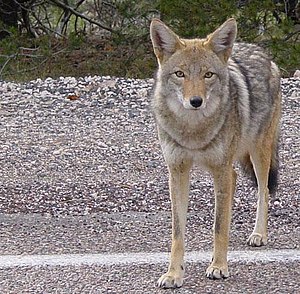
The string of sightings began Nov. 13 with the shooting of what appeared to be an unusually large coyote in Carroll County. The Missouri Department of Conservation (MDC) sought DNA tests to clarify the animal’s identity. Scientists sometimes can determine where an animal came from by comparing its DNA with DNA samples from animals of the same species from different areas.
The first round of testing compared DNA from the 104-pound canine to that of western timber wolves. The tests showed a poor match with western wolves but did confirm the presence of coyote DNA. However, further testing linked the animal to timber wolves.
“Coyotes seldom get bigger than 30 pounds in Missouri,” said MDC Resource Scientist Jeff Beringer. “A coyote weighing more than 100 pounds just didn’t seem credible. Wolves are known to interbreed with domestic dogs and coyotes, so we had further testing done to look for evidence of that, and we found it.”
The second round of DNA tests compared the Carroll County canine’s DNA with samples from timber wolves from the Great Lake states of Minnesota, Wisconsin or Michigan. This time, the tests found a close match. Wolves from that area are known to have coyote DNA in their genes. This accounts for the match with coyote DNA in the initial tests.
“Lots of people were skeptical when we announced results from the first round of testing,” said Beringer. “We were too. But when you are trying to unravel a biological puzzle like this one, you take things one step at a time and go where the science leads you. This animal appeared to be very different from the western wolf samples it was compared with, but when we compared it with wolf DNA from the Great Lake states we found a match.”
When asked how a Great Lakes wolf got to Missouri, Beringer noted that wolves from northern states have turned up in Missouri before. The most recent case occurred in 2001. It involved an 80-pound timber wolf killed by a landowner in Grundy County. The man mistook the wolf for a coyote, but discovered his mistake when he found the animal wore a radio collar and an ear tag linking it to Michigan’s Upper Peninsula, more than 600 miles away. He notified MDC, which was able to confirm its origin with Michigan officials.
MOUNTAIN LION DNA
Missouri’s other recent news about large carnivores consists of six confirmed sightings of mountain lions (Puma concolor), also known as cougars, since November. MDC verified three of those sightings – in Platte, Linn and St. Louis counties – with photos. MDC obtained hair from the cat photographed in Platte County, but DNA tests on the hair were only able to confirm that the animal was a mountain lion.
“We already knew that,” said Beringer. “The gentleman who saw it got photos that conclusively proved it was a mountain lion. We hoped DNA from the hair would enable us to learn where the animal came from, but hair is a poor source of DNA, and there just wasn’t enough to tell us more.”
Two confirmed sightings involved mountain lions that were shot by hunters, one on Dec. 31 and one on Jan. 15. With ample tissue for testing on these two animals, the DNA results were more revealing. Both had DNA consistent with mountain lions from South Dakota or northwestern Nebraska. Beringer said mountain lions from northwestern Nebraska and the Black Hills region of South Dakota are so closely related, it is almost impossible to distinguish between them.
Beringer said MDC uses other physical evidence to learn about mountain lions when their bodies are available for examination. Based on the condition of teeth and residual dark barring on their legs, the two male cougars shot by hunters were identified as being young animals.
“That is consistent with the theory that the cats we are seeing in Missouri are subadult males dispersing from their original home areas,” said Beringer.
Examination of the bodies of the two hunter-killed cats showed no evidence of them having been held in captivity. The stomach of the 115-pound cougar from Ray County was empty. The 128-pound cat from Macon County had eaten a rabbit. Both were in good physical condition. Further information about these and other confirmed mountain lion sightings is available at www.mdc.mo.gov/node/34168. The most recent confirmed sighting occurred in Oregon County March 9. That cat left a tuft of hair on a barbed-wire fence after crossing the road in front of a motorist. MDC retrieved the hair, and testing at the University of Missouri confirmed it as a mountain lion. Further testing is planned to learn more about the Oregon County cougar’s relationship to mountain lions from other areas.
One of the more intriguing but still unexplained twists to Missouri’s recent mountain lion sightings is the fact that a cougar photographed with a trail camera Dec. 29 in Linn County appears to have been wearing a radio-tracking collar. The shape of the collar’s antenna suggests that it is a VHF transmitter, rather than one of the newer GPS collars that enable wildlife researchers to track animals’ movements continuously via satellites.
“I have made a lot of calls to other states trying to identify that animal, but so far my only lead is a missing, collared, subadult male from Utah. That would be one heck of a move – but not impossible,” said Beringer.
He noted that collars of the type the Linn County mountain lion was wearing have a short range, and their batteries eventually wear out. The transmitter might have been out of service before the cat left the area where it was collared, leaving the researcher who was tracking it unaware of its departure.
MANAGING PREDATORS
The March 9 sighting brings the number of verified Missouri mountain lion reports to 16. The first of these modern-day sightings was in 1994. Prior to that, the last confirmed sighting dates back to when the species was extirpated, in the early 20th century.
Confirmed cougar sightings have been infrequent in recent decades. The spate of six confirmed sightings in four months surprised even experts like Beringer. He said the uptick in sightings could be a hint of things to come.
“Nebraska went from where we are now – having occasional verified sightings of dispersing animals – to having a breeding population in the space of 10 years. Young male mountain lions are the ones that most often leave their home areas, but I think it is realistic to expect that females will arrive here eventually. We need to be thinking about what we will do if mountain lions establish a breeding population here at some point in the future.”
Beringer noted that what is happening with mountain lions today is similar to what has been happening with bears for several decades. The Arkansas Game and Fish Commission restored black bears (Ursus americanus) to that state starting in 1958. As bears filled up suitable habitat in Arkansas, a few individuals began dispersing north into Missouri. Today, the Show-Me State has a breeding population of bears, and MDC is developing strategies for managing the species.
MDC’s current policy regarding mountain lions, approved by the Missouri Conservation Commission in 2006, is not to encourage the establishment of a breeding population of mountain lions. The state’s Wildlife Code protects mountain lions. However, it also allows people to kill any mountain lion that is attacking or killing livestock or domestic animals or threatening human safety. Anyone who kills a mountain lion must report it to MDC immediately and turn over the intact carcass, including the pelt, within 24 hours.
The same applies to wolves and bears.
“The return of these long-absent predators is exciting to many Missourians,” said Beringer, “but it is frightening to others. Much of the fear is simply due to unfamiliarity. These animals are naturally shy of people and seldom cause problems, even in states that have thriving breeding populations.”
Beringer said contrasting the frequency of mountain lion attacks with more familiar dangers helps put the risk in perspective. For example, more than 50,000 people die in automobile accidents in the United States annually, and 86 people are killed by lightning. In contrast, deaths from mountain lion attacks have averaged one every seven years since 1890.
“Having mountain lions around again seems scarier than it really is because it’s new,” said Beringer. “But it would be a terrible pity if people let that keep them from enjoying the outdoors. We don’t let fear of traffic accidents or lightning keep us indoors. We shouldn’t let fear of predators scare us unnecessarily either.”
The Conservation Department set up the Mountain Lion Response Team in 1996 to track cougar sightings and investigate those instances where physical evidence – such as photos, video, footprints, scat or hair – exists. To report a sighting, contact any MDC office or conservation agent, or send email to mountain.lion@mdc.mo.gov.


