Showing posts with label Niangua River. Show all posts

Sunday, October 20, 2013

Autumn is a great time for trout fishing

Missouri’s trout parks, streams, and lakes are more beautiful than ever right now.

SPRINGFIELD – Note to trout anglers: Just because leaves are changing colors and your friends are talking about hunting deer, ducks, or small game doesn’t mean you have to put your fishing gear away.
Courtesy MDC
Trout fishing is hardly a secret in Missouri, but for many people, it’s not in the spotlight in autumn like it was back on March 1 when thousands of anglers participated in the state’s annual trout park opener. At this time of year, many people are planning hunting trips or are trying to squeeze in a couple more trips to the lake before winter fishing patterns – and winter temperatures – set in. For many, this will involve outings where adults can pass on their knowledge and love of the outdoors to children and grandchildren. For others, it means finding solitude and getting away from computers, meetings, and other stressors of work.

All this leads back to trout. Even though (to paraphrase Robert Frost) trout fishing is the road not frequently taken in terms of outdoor choices at this time of year, a trout-fishing trip can provide outdoor entertainment and tasty table fare for nature-lovers of all ages.

“Fall is a good time to fish the trout streams in Missouri,” said Craig Fuller, Missouri Department of Conservation fisheries biologists who oversees trout-management areas at Bennett Spring State Park and on the Niangua River. “You have nice weather, a lack of recreational float traffic, beautiful fall colors, usually stable and clear stream flows, and trout are actively feeding as they get ready for winter.”

The same holds true for Missouri’s four trout parks.

“Typically, October has fewer anglers than the summer months of June, July, and August,” said Mike Mitchell, who manages the MDC hatchery at Bennett Spring State Park in Laclede and Dallas counties. “The lower angler turn-out can make for a peaceful fishing experience. Water clarity during October is very good, which allows anglers to see the fish better. Fall colors and cooler weather make for a beautiful backdrop.”

The summer fishing season at Missouri’s four trout parks – Bennett Spring State Park, Roaring River State Park, Montauk State Park, and Maramec Spring Park – runs through Oct. 31. Fishing hours at the parks are from 7:30 a.m. to 6:30 p.m. daily. A daily trout tag is required to fish at the parks.
Don’t worry – those who fish the trout parks in October won’t have to settle for summer’s left-overs. The streams at all four parks are stocked daily (based on predicted anger attendance) through the end of the month. That means, in October, approximately 30,000 fish are stocked at Bennett Spring, Roaring River, and Montauk, and 10,000 are put into the water at Maramec Spring. The size of the fish trout-park anglers can catch range from 12-inch stockers to lunkers that weigh between three and eight pounds.

After the trout parks’ summer seasons end October 31, all four areas will re-open for the winter catch-and-release season, which runs from November 8 through February 10. As the season’s name states, it is for catch-and-release fishing only – no trout may be kept.

Not all the trout parks are open every day during this season. The three state parks (Bennett Spring, Roaring River, and Montauk) are open for fishing on Fridays, Saturdays, Sundays, and Mondays from 8 a.m. to 4 p.m. each day. Maramec Spring Park is open from 8 a.m. to 4 p.m. each day. During the winter season at the trout parks, you don’t need to buy a daily trout park tag when you fish. You will need a trout permit and, if you are age 16 through 64, a Missouri fishing permit.

Lake Taneycomo in Taney County is another well-known Missouri trout fishery that is a great place to fish in the fall. As is the case with trout parks, trout stocking continues at Taneycomo at this time of year. (The lake is stocked each month throughout the year.) In October, more than 60,000 trout are put into the lake. Anglers can also visit Shepherd of the Hills Hatchery at the west end of Taneycomo (just below Table Rock dam) to learn how trout are raised.

If none of this has caught your fishing fancy, don’t forget about Missouri’s trout streams. There are several Ozarks streams that, because of suitable habitat conditions, are capable of sustaining trout populations. Under the Conservation Department’s trout management plan, these trout streams are categorized as either white ribbon trout areas, red ribbon trout areas or blue ribbon trout areas. The differences between the classifications have to do with differences in regulations and management strategies. Like the trout parks and Taneycomo, some trout streams also receive fall stockings.
“Managed trout streams get stocked at different rates and some get stocked more frequently than others,” Fuller said. “But, yes, there are trout-managed streams that get stocked in the fall.” As an example, Fuller said the Niangua River White Ribbon Trout Area gets stocked every month of the year with rainbow trout, From October through February, its gets stocked twice a month. Anglers are reminded that they need to purchase a trout permit to possess trout on Missouri’s white, red or blue ribbon trout streams and to fish at Lake Taneycomo upstream from the U.S. Highway 65 Bridge.
More information about trout-fishing opportunities in Missouri can be found at your nearest Conservation Department office or at www.missouriconservation.org.

Thursday, December 30, 2010

2010 a year of bold conservation initiative

The Flag of the State of MissouriImage via Wikipedia
Under new leadership, the Missouri Department
of Conservation tackled challenges old and new.
JEFFERSON CITY–Looking back on 2010, historians are likely to describe a year when economic challenges spurred conservation innovations and a new leadership team launched ambitious initiatives. It was also a year when the Show-Me State’s world-class fishing repeatedly made national news.

 As 2010 began, revenue from Missouri’s one-eighth of 1-percent conservation sales tax was in its fourth consecutive year of decline. Sales-tax income fell from $103.3 million in Fiscal Year ’07 to $93.9 million in FY ’10, and projected sales-tax income for the current fiscal year was projected to be $92.7 million. To adapt to falling revenues, MDC moved to cut its workforce by 10 percent, close 13 offices and adjust some programs.

While implementing these budget cuts, the agency got new leadership. Bob Ziehmer replaced retiring Director John Hoskins on Jan. 15. By July 1, six of the agency’s 10 division chiefs had retired as part of MDC’s payroll reduction effort and were replaced from within the agency’s ranks. Over the course of the year, MDC’s new leadership team launched several initiatives to achieve further cost savings or advance MCD’s mission.

They unveiled the year’s first initiative in February, announcing plans to test a new system for assigning waterfowl hunting opportunities on three of its managed wetland areas. “Quick Draw,” as the new system is known, went into effect at Eagle Bluffs, Grand Pass and Otter Slough conservation areas (CAs) in the fall as a test to determine whether the online system could enhance convenience and hunter participation while saving money. Thousands of hunters tried the new system, and managers of the three areas said they noticed an increase in the number of new faces arriving for waterfowl hunts. Hunters who took part in “poor line” drawings for unreserved hunting spots found more opportunities than expected under the new system. MDC will evaluate the system’s effectiveness after the hunting season before deciding whether it should be expanded to other areas.

In March, MDC announced plans to distribute nearly $6 million in grants to help seven schools reduce energy costs, create jobs and provide incentives for better forest management. The Fuels for Schools grant program was a cooperative effort with the USDA Forest Service and was funded through the American Recovery and Reinvestment Act. It helped participating schoolsinstall boiler systems that use woody biomass to heat and cool their facilities. Besides cutting schools’ fuel bills, the program helps reduce dependence on fossil fuels, supports local employment and supports the state’s forest industry. It also benefits conservation by giving landowners a financial incentive to conduct timber-stand improvements harvests and other management practices that enhance forest productivity and wildlife habitat.

Perhaps the most heralded initiative launched in 2010 was a plan to restore elk to a 346-square-mile area in parts of Shannon, Carter and Reynolds counties. The Conservation Commission approved the plan in October, and MDC forged ahead immediately. Elk will be released into the wild at Peck Ranch Conservation Area (CA) in late April or early May.

Expected benefits of elk restoration include restoring a key ecological link to the Ozarks, boosting Missouri’s tourism industry and providing hunting opportunities once the herd can sustain a harvest. The full elk-restoration plan is available at www.mdc.mo.gov/elk/.
Following is a month-by-month roundup of some of the year’s other significant conservation-related events.

JANUARY
Anglers made some of the Show-Me State’s biggest news last year. The action began Jan. 19, when 15-year-old Joshua Lee Vance of Bolivar gigged the 4-pound, 5-ounce white sucker from the Niangua River. It was the first white sucker entered in the “alternate methods” category.
Around the same time, archery deer hunters were wrapping up their four-month-long season. The 2009-2010 archery deer harvest topped 50,000 for the first time in the modern bowhunting season’s 64-year history.
Thanks to deer hunters’ success, the Conservation Federation of Missouri reported brisk activity in the Share the Harvest program, which encourages hunters to donate venison to food pantries. Donations topped 252,000 pounds of venison during the 2009-2010 hunting season and brought the total for the program’s 18-year history to more than 2 million pounds.
 
FEBRUARY
The first issue of Xplor: kids’ adventures in nature arrived in mailboxes around the state. The bi-monthly magazine does for readers 7 to 12 years old what Missouri Conservationist magazine does for adults.
Testing confirmed chronic wasting disease (CWD) in a captive whitetail deer at a private hunting ranch in Linn County. Testing of deer from the ranch and of free-ranging deer from surrounding parts of Linn, Macon and Chariton counties found no sign of the disease, which affects deer, elk and moose. MDC continues CWD monitoring efforts that began in 2001.
More than 600 youths took part in Missouri’s second National Archery in the Schools state tournament. The program’s ranks have swelled to approximately 16,000 youths in just four years. This remarkable growth rate is evidence of archery’s enduring appeal.
 
MARCH
As winter faded into spring, state and federal officials issued fire warnings for a number of counties in southern and central Missouri, indicating an extreme danger of wildfire. The immediate causes of the danger were high winds, low humidity and a prolonged dry spell. However, the underlying causes go back three years, during which ice storms and high winds dumped countless tons of woody debris on the ground. Missouri got through the spring fire season without a major fire disaster. However, fire officials warn that the abundance of woody fuel will continue to pose a threat for a decade.

APRIL
On April 9, Nicholas Wray, of Harrisonville, caught a 2-pound, 4-ounce black bullhead from a Cass County farm pond using a jug line. The bullhead nudged aside the previous record by 4 ounces.
Hunters kicked off Missouri’s second half-century of turkey hunting in April. Unregulated hunting had almost eliminated the wild turkey from the Show-Me State by the 1930s. It took three decades of careful stewardship to rebuild the flock to the point where it could support a three-day hunting season in 14 Ozarks counties in 1960. Hunters checked 94 turkeys in the spring season that year. In 2010, the figure was 46,199, confirming Missouri’s status as one of the nation’s top turkey-hunting destinations.
 
MAY
Oak trees across a broad swath of Missouri experienced an unusual outbreak of a common parasite, the jumping oak gall wasp. The insects lay eggs in leaves, producing tiny, button-like growths that turn leaves brown. When the galls fall to the ground, larvae inside start moving around, causing the galls to jiggle, slowly working their way into protected spots. Tree experts reassured tree owners that the parasite is not fatal to healthy trees, even though the condition can look awful.
 
JUNE
One of Missouri’s most familiar invasive species, the zebra mussel, turned up on a private boat lift during an inspection of the Camp Branch Marina in Smithville Lake. MDC and U.S. Army Corps of Engineers worked together to eradicate the infestation later in the summer by applying almost 400 gallons of a commercial algaecide to the water around the marina.

The Lake City Shooting Range and Education Center in Jackson County, improving recreational shooting opportunities for Kansas City area residents.

JULY
Missouri’s world-class fishing made national news on July 8 when John West, of Republic, caught a 58-pound, 10.4-ounce striped bass at Bull Shoals Lake in Taney County. At that time, the International Game Fish Association (IGFA) line-class record for inland waters was 47 pounds, 11 ounces.

In the early hours of July 20, Greg Bernal, of Florissant, caught a 130-pound blue catfish on a handheld fishing pole while fishing on the Missouri River north of St. Louis. The monster topped Missouri’s previous pole-and-line record for blue catfish by 27 pounds.

July’s third record was a 99-pound flathead catfish caught by Robert Neal Davidson, of Mokane.

On July 17, MDC culminated a two-year undercover investigation in Crawford, Dent, Howell, Iron, Miller, Oregon and Shannon counties. Most of the 425 serious violations documented by state and federal wildlife officers were related to deer and turkey.

The Conservation Department, in cooperation with the St. Louis Zoo, released the first captive-reared eastern hellbenders into the Big Piney River this month. The release was part of efforts to help the endangered salamanders recover.

Efforts to restore alligator gar populations in southeast Missouri made national television in a National Geographic documentary that aired late in July.
 
AUGUST
At its Aug. 20 meeting in Jefferson City, the Conservation Commission announced that it would appeal a judgment by Ripley County Circuit Judge Robert Smith concerning regulations that prohibit the use of motorized vehicles and dogs for deer hunting. Smith had ruled earlier in the month that the regulations were unconstitutionally vague.

Missouri’s Golden Anniversary Wetland Initiative forged ahead with renovation work at Duck Creek CA. The initiative is replacing aging infrastructure at Missouri’s oldest managed wetland areas.

SEPTEMBER
In September, MDC announced the closure of Missouri’s ruffed grouse hunting season for the first time in more than 25 years. Grouse numbers remained low despite  repeated attempts to reintroduce grouse in areas with suitable habitat. MDC and the Ruffed Grouse Society were seeking a source of grouse to resume reintroduction work, so hunting grouse made no sense while restoration work was under way.
 
OCTOBER
George Pittman Sr. put Missouri fishing back in the news on Oct. 12 by landing an 8-pound, 3-ounce shortnose gar with a rod and reel at LakeContrary in his home town of St. Joseph. It topped the previous Missouri state record by 3.5 pounds and was more than a pound heavier than the current IGFA record.

Black bears also made the news as MDC launched a multi-year field study of Missouri’s growing bear population. The study will provide information about movement patterns, population densities, habitat preferences and overall numbers of Missouri bears. The data will establish a firm scientific basis for bear management, so that bears continue to thrive and expand into suitable habitats with minimal conflicts with people. Hunting is expected to be part of Missouri’s long-term bear management strategy.

A weekend of free shooting heralded the reopening of the Jay Henges Shooting Range at High Ridge, augmenting public opportunities for recreational shooters in the St. Louis area.
 
NOVEMBER
Just in time for deer season, the Missouri Court of Appeals stayed Ripley County Circuit Judge Robert Smith’s ruling on hunting deer with dogs and vehicles. The Court of Appeal’s order enabled conservation agents to continue enforcing the contested Wildlife Code provisions until MDC’s appeal is resolved.
When deer hunters went afield during the November portion of Missouri’s firearms deer season, their ranks included a few practical historians wielding atlatls, spear-throwing devices used by humans as long as 30,000 years ago. No atlatl kills were reported.

Gov. Jay Nixon shot an 8-point whitetail buck on opening morning of the November deer hunt and donated the venison to needy Missourians through Share the Harvest. Earlier in the fall, Gov. Nixon announced that Share the Harvest had the resources to underwrite processing of up to 10,000 deer, more than double the number in previous years. The expansion was possible because of a partnership between Gov. Nixon, MDC, the Conservation Federation, and local food banks. For each whole deer contributed, the Conservation Federation reimbursed local processors $60, up from $40 in 2009. In many cases, local charities covered the balance of the processing cost, making donations free for hunters. Through efforts like this, the Conservation Federation hopes to boost venison donations to half a million pounds annually.
 
DECEMBER
In December, MDC construction crews working with teams from Kentucky and Virginia began building elk traps and pens in Kentucky. The next step is construction of a holding pen at Peck Ranch CA. The Appalachian Wildlife Foundation and the Rocky Mountain Elk Foundation pledged financial support totaling $350,000 for Missouri’s elk-restoration efforts.

MDC announced that it had confirmed the 11th mountain lion sighting in Missouri since the big cats disappeared from the Show-Me State in the mid-1800s.  A landowner in southern Platte County near the Missouri River contacted MDC with a photograph he took of a mountain lion in a tree on his property. The confirmation came after experts examined the photo and interviewed the landowner, who asked to remain anonymous. MDC experts also examined claw marks on the tree where the big cat was photographed and gathered hair samples for DNA testing in hopes of gaining information about the animal’s origins.

With 18 days of archery deer hunting and the late portion of youth deer season still ahead, Missouri’s 2010-2011 deer harvest stood at 269,759.
-Jim Low-


Enhanced by Zemanta

Friday, December 3, 2010

Enhanced habitat for threatened fish, improved driving conditions for Dallas County residents: Recovery Act bridge replacement project complete in Southwest Missouri

Map of the Osage River watershed.Image via WikipediaThe U.S. Fish and Wildlife Service celebrates today the completion of a new bridge within the Osage River Basin that will enhance habitat for the Federally threatened Niangua darter and improve driving conditions for Missouri drivers. The Service's Columbia Fish and Wildlife Conservation Office (FWCO) worked cooperatively with the Missouri Department of Conservation (MDC) to replace the Benton Branch river crossing over the Niangua River in Dallas County using funding provided by the American Recovery and Reinvestment Act of 2009.

Fly fishing for Trout in Missouri
Enhanced by Zemanta

Friday, August 21, 2009

Fishing Missouri's Forgotten Trout River - The Niangua River

Fishing Missouri's Forgotten Trout River - The Niangua River
By Davidson Manning

Niangua River, MOImage by Kyro S via Flickr


The Niangua River may be the most overlooked trout stream in the state of Missouri. It is widely known across the state as an excellent river for floating and smallmouth bass fishing, but the trout fishery is little known. Most area trout anglers only fish in the Niangua River's tributary, Bennett Spring Branch.

Above Bennett Spring Branch, the Niangua is a typical warm-water fishery. Smallmouth bass fishing is very good, but few trout are present. It is the cooling flows from Bennett Spring that make the river into a true trout stream. For eleven miles, the water is cool enough to hold year-round populations of rainbow and brown trout. Both species are stocked regularly.

The Niangua River isn't like other trout streams in the Ozarks. First of all, it just doesn't look like a trout stream. The river is big, and it usually isn't very clear. Also, the water temperature is usually above 70 degrees for most of the summer. With that said, for some unknown reason, the Niangua River does fish well all summer long, even when water temperatures are quite high. It is not uncommon to catch trout when the water temperature is 75 degrees. In other words, it's hard to believe trout do well in the Niangua, but they do.

Rainbow trout are the most common catch in the Niangua. They are stocked every few weeks during the spring, summer, and fall, and a good number also escape from Bennett Spring Branch into the river. They are easy to catch on a Powerbait, worms, small spinners, and spoons. Brown trout are not quite as common, but a good number can be found in the river. They respond better to small crankbaits, nightcrawlers, minnows, and crayfish. Both species of trout can be caught on a variety of flies including Woolly Buggers, Prince Nymphs, Pheasant Tail Nymphs, and Caddis imitators.

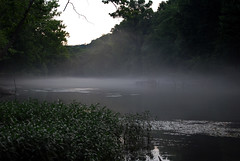
Mist on the Niangua in MissouriImage by Kyro S via Flickr


You can access the Niangua River's trout water at three points. The first is the Bennett Spring Access, where Bennett Spring Branch meets the Niangua. This is probably the most popular access point, and fish are always plentiful. The next access point is at Barclay Conservation area. This is a few miles downstream from the Bennett Spring Access. Fishing is very good in this area, especially for brown trout. The final access point is at Prosperine. Trout populations are a bit lower in this area, but you can find some of the biggest brown trout in the river both up and downstream of this access. Smallmouth bass are also abundant. Fishing regulations on the Niangua allow for all baits, lures, and flies to be used. Four trout may be kept, and there is no minimum length limit on rainbow trout. There is a 15" length limit on browns. In addition, only one brown may be kept. There are many other fantastic Missouri Trout fishing opportunities, but don't neglect this gem of a river!

No matter where you access it, the Niangua is a great stream. It may not be popular to trout fisherman, the fishing is very good. You'll see lots of floaters, especially in summertime, but fisherman will be few. This river is certainly worth a trip. If you have trouble, you can always drown your sorrows by catching a few stockers over at Bennett Springs.


Davdison Manning is an avid outdoorsman spending over 100 days per year pursuing his passion for fishing, many of them in the Ozarks of Missouri and Arkansas. He details many of his favorite spots on his website Family-Outdoors. His other pursuits include many days spent in the field camping and hunting. Davidson loves to share his knowledge of the outdoors in the hope of helping others to find their own connection to the outdoors.


Reblog this post [with Zemanta]

10 Tips to Keep Your Outdoor Gear in Working Order and Well Organized

Camping Gear - It's expensive to buy, make it last. Maintaining and organizing your outdoor gear is crucial for ensuring it remains func...