Showing posts with label White nose syndrome. Show all posts

Friday, March 29, 2013

Bat disease recently found in Franklin, Washington counties


Caves where White Nose Syndrome found closed to public to prevent disturbing remaining bats. 

Courtesy MDC
JEFFERSON CITY, Mo. – The U.S. Geological Survey (USGS) National Wildlife Health Center has confirmed that a deadly disease in bats called “White Nose Syndrome” (WNS) has been recently found in a little brown bat and a tri-colored bat from a public cave in Washington County. The USGS has also confirmed that WNS has been recently found in a little brown bat and a northern long-eared bat from two public caves in Franklin County. All three caves are closed to the public, and cave names are not being disclosed to prevent disturbance of remaining bats.  

The name of the disease describes a white fungus typically found on faces and wings of infected bats. The WNS fungus thrives in cool, damp conditions found in many caves, which are also hibernation and roosting sites for many bat species. WNS spreads mainly through bat-to-bat contact and has not been found to infect humans or other animals. The fungus that causes WNS may be inadvertently carried between caves by humans on clothing, footwear and caving gear.

According to the Missouri Department of Conservation (MDC), signs of the disease or the fungus have now been confirmed in 19 bats from caves in Crawford, Franklin, Lincoln, Perry, Pike, Shannon, and Washington counties since WNS was first found in Missouri in 2010.

“Bats with WNS exhibit unusual behavior, such as flying outside in daylight and clustering near entrances of caves and mines during the day in cold winter months when they should be hibernating,” said MDC Bat Biologist Tony Elliott. “This activity uses up fat reserves needed to get the bats through the winter, making them more susceptible to freezing or starvation.”

Elliott cautioned that people should not handle any bats, and should contact their local MDC office or conservation agent if they find dead bats, or see bats flying outside during the day in cold winter months when they typically would be roosting or hibernating.

Missouri is home to more than 6,300 known caves with about 74 percent of them privately owned. Many contain bats. Bats provide tremendous value as natural pest control for farms and forests, and also play an essential role in helping to control insects that can spread disease to people. According to the USGS, the number of North-American bats estimated to have died from WNS thus far had the capacity to consume up to 8,000 tons of insects per year.
More information on WNS is available online at whitenosesyndrome.org andfws.gov/northeast/pdf/white-nosefaqs.pdf.

Saturday, January 26, 2013

White-Nose Syndrome confirmed in bat at Onondaga Cave


Onondaga Cave State Park’s cave will remain open for tour season; disease has not been found to infect humans

For more information: 573-751-1010
Volume 41-005   FOR IMMEDIATE RELEASE: January 25, 2013

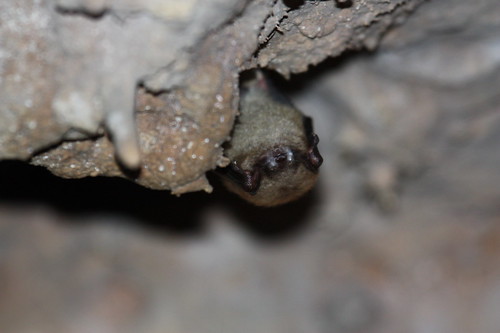
Little brown bat with visible fungus from Onondaga Cave
ittle brown bat with visible fungus collected at Onondaga Cave
Photo credit: MDC/Shelly Colatskie
JEFFERSON CITY, Mo. — Missouri State Parks has received confirmation that a bat found in the entrance of Onondaga Cave at Onondaga Cave State Park in Crawford County has tested positive with white-nose syndrome. WNS spreads mainly through bat-to-bat contact and has not been found to infect people, pets or livestock but is harmful or lethal to hibernating bats. The fungus that causes WNS may be inadvertently carried between caves by humans through clothing and equipment.
The U.S. Geological Survey’s National Wildlife Health Center http://www.nwhc.usgs.gov confirmed the bat had the disease described as a white fungus, or Geomyces destructans, which is typically found on the faces and wings of infected bats.
Education is an important aspect of the overall effort to manage WNS and part of the state park system mission. In 2010, Missouri State Parks staff began educating and screening visitors before each cave tour to help minimize risks to bats. While WNS is mainly transmitted bat to bat, scientists believe that the fungus can be carried on clothing, footwear and caving gear, therefore, staff will require visitors to wear only clothing and bring equipment that has not been in another cave before. In addition, staff took action to protect the bats from disturbance while hibernating in caves and adjusted the touring season to avoid disturbing the bats in fall and spring when they are gathering for, or preparing to leave, hibernation.
Missouri State Parks has a dual responsibility of preserving nature while providing opportunities for people to enjoy our state parks. Nearly 20,000 people visit Onondaga Cave every year. Staff will continue to provide information and require additional measures for visitors to follow both before and after a cave tour when the cave opens for the tour season to help reduce the risk of cave-to-cave transmission of the fungus.  
The U.S. Fish and Wildlife Service has indicated that WNS has killed at least 5.5 million cave-dwelling bats since the disease was first detected in New York in 2006. Signs of the disease have spread to 21 states and the disease has been confirmed in 19 states and four Canadian provinces. Signs of the disease were first discovered in Missouri in 2010. Today, signs of the disease or the fungus have been confirmed in 15 bats from caves in Pike, Shannon, Lincoln, Perry, Washington and now Crawford counties.
More information on WNS is available at www.whitenosesyndrome.org. For more information on Missouri State Parks and Onondaga Cave State Park, visit the Web at mostateparks.com. Missouri State Parks is a division of the Missouri Department of Natural Resources.  

Sunday, May 1, 2011

Missouri state park major tour caves open to visitors in 2011

Stalactiflat, Fisher Cave, Meramec State Park,...Image via WikipediaJEFFERSON CITY, MO., APRIL 12, 2011 -- Visitors to Missouri state parks this summer will have the opportunity to tour the system's four major tour caves. Many other caves that are commonly used by bats will remain temporarily closed to reduce the risk of spreading white-nose syndrome, a fungus that affects bats but not humans.

White-nose syndrome is a fungus that has devastated bat populations throughout the northeastern United States and is spreading west. Bats showing evidence of the fungus were found in 2010 in two caves in Missouri. Restricting public access to certain caves is believed to help reduce the risk of any people-born transmission of the fungus from cave to cave.

"We have been monitoring this situation closely and have made decisions based on what we believe protects our resources while still allowing visitors some form of access to the unique experience you can only find in caves," said Bill Bryan, Missouri Department of Natural Resources' State Parks director.

The four tour caves that will be open are Onondaga Cave at Onondaga Cave State Park (open for local school groups and the general public April 15); Cathedral Cave at Onondaga Cave State Park (open to local school groups on April 15 and May 15 to the general public); Fisher Cave at Meramec State Park (open to local school groups on April 16 and May 15 to the general public); and Ozark Caverns at Lake of the Ozarks State Park (open to local school groups on April 16 and May 15 to the general public). To help prevent the risk of human transmission of the fungus from cave to cave, screening measures will remain in place. Visitors who tour the caves are asked to not wear the same clothing, footwear, accessories or equipment that has been in any other cave.

In 2010, most of the park system's wild caves used by bats were closed except for specific exceptions like educational tours and low-risk groups in specified wild caves. While this policy remains in effect, the number of caves that may be accessed for educational and scientific purposes in 2011 has increased.

"This year, we have more clearly identified caves that we believe can be used for certain purposes, especially school groups and other educational efforts. This allows us to provide access to more caves while still protecting the resources," said Bryan. The accessible caves include shorter caves, those that do not have bats, and those caves that have exceptional educational value for schools.

To find out which caves can be accessed, contact the individual park where you would like to visit a cave. For more information about cave tours, visit mostateparks.com/activity/cave-tours.

State park staff will continue to work with other state and federal resource agencies, including the U.S. Fish and Wildlife Service and the Missouri Department of Conservation, on a management plan to address white-nose syndrome in Missouri state park caves.

Missouri has more than 6,300 caves. Bryan emphasized the agency policy concerning the 183 caves in 18 state parks and historic sites does not apply to other caves in Missouri. Most if not all commercial cave tour operations remain open for business. For information on privately owned caves or those operated by other agencies in Missouri, contact the agency or private business or landowner that owns the cave. Information on other caves can be found at mocaves.com

Enhanced by Zemanta

10 Tips to Keep Your Outdoor Gear in Working Order and Well Organized

Camping Gear - It's expensive to buy, make it last. Maintaining and organizing your outdoor gear is crucial for ensuring it remains func...