Showing posts with label Macon. Show all posts

Saturday, April 6, 2013

CWD remains confined to Linn-Macon-County Core Area

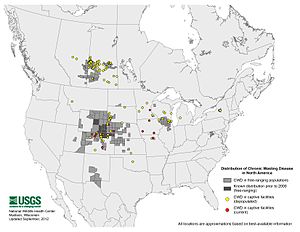
English: Distribution of Chronic Wasting Disea...
Distribution of Chronic Wasting Disease in the North America in April 2007 (Photo credit: Wikipedia)

Four new cases from targeted deer reduction brings total to 10 in Missouri free-ranging deer.

JEFFERSON CITY, Mo. – The Missouri Department of Conservation (MDC) has confirmed four more cases of chronic wasting disease (CWD) in free-ranging deer. The four deer were among 102 harvested in January and February in the CWD Core Area of Linn and Macon counties. The Core Area is comprised of a 29-square-mile block along the northern part of the Linn- and Macon-county border where CWD was first detected in free-ranging deer in early 2012. The intensive sampling effort was conducted by MDC and participating landowners to monitor infection rates, and limit the spread of the disease by reducing local deer numbers.

These four new cases bring the total confirmed cases of the disease to 10 in Missouri free-ranging deer with all from the small section of Linn and Macon counties.

MDC tested 3,225 harvested deer statewide for CWD last year, including 196 from the CWD Core Area, and 1,783 from the Department’s larger six-county CWD Containment Zone consisting of Adair, Chariton, Linn, Macon, Randolph and Sullivan counties. MDC has tested more than 38,000 deer for the disease since 2001.

“Our extensive CWD testing indicates we caught the disease while it is still limited to a small number of deer in a very concentrated area,” says MDC State Deer Biologist Jason Sumners. “We hope that by reducing deer numbers in the Core Area, we can remove those with CWD. This will help reduce the spread of the disease to other deer in the area, and prevent, or at least dramatically slow, the spread to other areas of Missouri.” 

Sumners adds that more than 90 percent of Missouri land is privately owned, so landowners are vital to deer management and to MDC’s efforts to limit the spread of CWD.

“We greatly appreciate the cooperation of these local landowners,” Sumners said. “The effort to reduce deer numbers within the 29-square-mile core area will help protect the health of deer throughout the state.”

He added that MDC will continue testing harvested free-ranging deer for CWD during future deer seasons.

Saturday, May 26, 2012

MDC to hold open house on CWD next steps June 2 in Macon County

English: Distribution of Chronic Wasting Disea...
English: Distribution of Chronic Wasting Disease April, 2007 (Photo credit: Wikipedia)
Open house will be at New Cambria High School June 2 between 1-4 p.m.

JEFFERSON CITY Mo. – The Missouri Department of Conservation (MDC) will hold an informational open house on Chronic Wasting Disease (CWD) in Macon County on June 2 at New Cambria High School, 501 S. Main St. The public is invited to stop by 1-4 p.m.

MDC staff will provide information on five recently found cases of CWD in free-ranging deer in northwest Macon County, explain disease management actions the Department is taking, answer questions and provide information on managing private land for deer.


MDC’s disease-management steps to help contain the spread of CWD include two regulation changes to the Wildlife Code of Missouri, recommendations on transportation and disposal of deer carcasses and continuing CWD sampling of deer harvested in the area where CWD has been found.
Restriction on Feeding

The Conservation Commission approved a regulation change at its May 25 meeting that places a restriction on activities that are likely to unnaturally concentrate white-tailed deer and promote the spread of CWD. The ban on the placement of grain, salt products, minerals and other consumable natural or manufactured products is limited to the area where CWD has been found in Macon County and is comprised of Adair, Chariton, Linn, Macon, Randolph and Sullivan counties.

The regulation includes exceptions for backyard feeding of birds and other wildlife within 100 feet of any residence or occupied building, or if feed is placed in such a manner to reasonably exclude access by deer. The regulation also includes exceptions for normal agricultural, forest management, crop and wildlife food production practices.

According to MDC Deer Biologist Jason Sumners, the reason for the regulation change is that activities such as feeding and placement of minerals/salts that artificially concentrate deer greatly increase the likelihood of disease transmission from animal to animal or from soil to animal.

Removal of Antler-Point Restriction
The Conservation Commission also approved a regulation change at its May 25 meeting for a special harvest provision that rescinds the antler-point restriction (four-point rule) in Adair, Chariton, Linn, Macon, Randolph and Sullivan counties.

According to Sumners, the reason for the regulation change is that management strategies such as antler-point restrictions, which protect yearling males and promote older bucks, have been found to increase prevalence rates and further spread the disease.

Sumners explained that yearling and adult male deer have been found to exhibit CWD at much higher rates than yearling and adult females so a reduction in the number of male deer can help reduce the spread of CWD. He added that the movement of young male deer from their birth range in search of territory and mates is also a way of expanding the distribution of CWD.
Don’t Remove Carcasses from Area

MDC also encourages hunters who harvest deer in Adair, Chariton, Linn, Macon, Randolph, and Sullivan counties not to take whole deer carcasses or carcass parts out of the area where CWD has been found.  Exceptions to this include meat that is cut and wrapped, meat that has been boned out, quarters or other portions of meat with no part of the spinal column or head attached, hides or capes from which all excess tissue has been removed, antlers, antlers attached to skull plates or skulls cleaned of all muscle and brain tissue, upper canine teeth and finished taxidermy products.

According to Sumners, the reason for this regulation change is that CWD can be transmitted from the environment to deer through soil and water that contain infected waste and/or infected carcasses. Deer can be infected with CWD but have no visible signs or symptoms. Moving harvested deer that still have parts known to concentrate CWD (brain, spinal cord, eyes, spleen, and lymph nodes) from the area known to have CWD can introduce the disease to other parts of the state through the improper disposal of carcasses.

He explained that hunters should make every attempt to avoid moving the head and spinal cord from the area and properly dispose of potentially infected deer carcasses, including bones and trimmings, to minimize the risk of exposure to uninfected deer. MDC advises hunters to double-bag carcass parts and take them directly to a landfill, or place them in trash cans for pick-up. Burying carcass waste deep enough to prevent scavengers from digging it up is another acceptable option. As a last resort, and only on their own land, hunters can put carcass waste back on the landscape. Carcasses should be put as close as possible to where the deer was harvested so as to not spread CWD-causing prions to new locations. If possible, put the carcass in a location where it will be inaccessible to scavengers and other deer.

Fall Harvest CWD Sampling

Sumners added that MDC will also continue to work with hunters who harvest deer this fall in Adair, Chariton, Linn, Macon, Randolph and Sullivan counties to collect samples for CWD testing. Details on these efforts are being developed and will be shared before the 2012 fall deer hunting season.

Wednesday, December 7, 2011

Hunters check 14,000 deer during antlerless season

English: A white-tailed deer
Image via Wikipedia

Two portions of Missouri’s firearms deer season remain.
JEFFERSON CITY–Hunters checked 14,439 deer during Missouri’s antlerless deer season Nov. 23 through Dec. 4.
This year’s antlerless harvest is 789 fewer than last year. Top harvest counties for the 12-day antlerless season were Benton with 394 deer checked, Pike with 390 and Macon with 378.
So far this year, firearms deer hunters have killed 221,490 deer. That is up 4,209 from the same time last year.
Two portions of Missouri’s firearms deer season remain. The muzzleloader portion runs from Dec. 17 through 27, and the late youth portion is Jan. 7 and 8.
Besides increasing hunting opportunities, the antlerless season gives landowners a way of regulating local deer numbers by allowing hunters to remove female deer from the population.
Missouri’s estimated population of 1.4 million whitetails enables hunters to shoot more than 250,000 deer each year. That yields approximately 10 million pounds of venison. Hunters consume most of this meat. However, hunters donate more than 250,000 pounds of venison annually to local food banks and other charities through the Share the Harvest program.
Wild venison has less fat than organic, free range beef, which sells for anywhere from $7 a pound for ground meat, to $30 for steaks. That puts the food value of Missouri’s white-tailed deer resource in the neighborhood of $200 million per year. Missouri’s deer resource also supports 11,000-plus jobs and generates more than $1 billion in business activity annually.
Economic value aside, deer hunting is a cherished tradition that draws thousands of Missouri natives back home to share healthful outdoor recreation with family and friends.

Sunday, October 30, 2011

MDC needs hunter help with CWD sampling of harvested deer

Distribution of Chronic Wasting Disease in the...Image via Wikipedia
Conservation Department asks deer hunters to allow MDC to collect tissue samples from deer harvested in north-central Missouri area for chronic-wasting-disease testing.


JEFFERSON CITY Mo – As part of its ongoing efforts to monitor Missouri’s free-ranging deer for chronic wasting disease (CWD), the Missouri Department of Conservation (MDC) is asking hunters for help.

MDC encourages hunters who harvest adult deer in Linn, Macon and parts of Adair, Chariton, Randolph and Sullivan counties during the early youth portion (Nov. 5-6) and first two weekends of the November firearms portion (Nov. 12-13 and Nov. 19-20) to take their deer to the following processors and roadside collection sites for tissue sampling during the following dates.

CHARITON COUNTY
  • · Salisbury Meat Market & Processing, 29047 Market Lane in Salisbury (Nov. 12-13)

LINN COUNTY
  • King’s Processing & Catering, 33181 Hwy WW in Marceline(Nov. 5-6, 12-13 and 19-20) 
  • Purdin Processing, 100 C St. in Purdin (Nov. 12-13 and 19-20)
  • Sprague’s Locker, 700 Brookfield Ave. in Brookfield (Nov 12-13)
  • Roadside Collection: Junction of Hwy 129 and Hwy 36 in Bucklin(8 a.m. – 5 p.m. Nov. 12-13 and 19-20)
  • Roadside Collection: Junction of Hwy 11 and Hwy 129 in New Boston (8 a.m. – 5 p.m. Nov. 12-13 and 19-20)
MACON COUNTY
  • Special D Meats, 30637 Lake St. in Macon (Nov. 5-6, 12-13 and 19-20) 
  • Buck Ridge Butcher Shop, 11245 Grouse Ave. in La Plata(Nov. 12 and 19)
  • Roadside Collection: Junction of Hwy 149 and Hwy Z in New Cambria (8 a.m. – 5 p.m. Nov. 12-13 and 19-20)
  • Roadside Collection: Junction of Hwy 149 and Hwy J in Goldsberry (8 a.m. – 5 p.m. Nov. 12-13 and 19-20)
SULLIVAN COUNTY

  • · Tucker’s Grocers & Processing, 355 W. Front St. in Green Castle (Nov 12-13)
“The process of collecting tissue samples will take only a few minutes and involves removing lymph nodes from the head,” said MDC Deer Biologist Jason Sumners. “The tissue sampling will not reduce the food value of deer. For those who harvest adult bucks and are worried about the taxidermy value of their mount, we are also working with many area taxidermists to collect tissue samples from adult bucks for CWD testing.”
Sumners added that hunters throughout the state who encounter or harvest deer in poor condition with no obvious injuries should contact their local conservation agent or MDC office. If appropriate, the deer will be tested for CWD.

He noted that the more than 500,000 Missouri deer hunters are vital partners in keeping the state’s deer herd healthy, along with the supporting the state economy.

“Adult deer have no widespread natural predators in Missouri so hunting is the primary way to control the population,” Sumners said. “Deer hunters spend more than $750 million directly related to deer hunting each year. This adds up to over $1 billion in overall business activity and supports more than 11,000 jobs.”

The voluntary hunter-harvested deer sampling effort is part of MDC’s response to a recent case of CWD found in a captive white-tailed deer. It is the second of only two confirmed cases of CWD with both found in captive white-tailed deer at two separate private, captive hunting preserves in Linn and Macon counties. The facility where the first case was reported in February 2010 has been depopulated.
The second case was identified by the Missouri Department of Agriculture (MDA) in October 2011 as a result of increased surveillance required by the management plan implemented from the previous CWD incident. The Missouri Departments of Agriculture and Conservation, in cooperation with the U.S. Department of Agriculture (USDA), continue their investigation of the incident.

CWD is a neurological disease that attacks the nervous systems of cervids, such as deer and elk, along with non-native cervids such as moose, red deer, fallow deer and sika deer. Cervids with clinical signs of CWD show changes in natural behavior and can exhibit extreme weight loss, excessive salivation, stumbling and tremors. CWD is thought to always be fatal to the infected animal, but it can take months or years before the symptoms of infection appear. CWD can spread through the natural movements of infected free-roaming cervids, the transportation of live captive cervids with CWD or the transportation of infected carcasses. CWD in deer can only be confirmed by laboratory examination of the brain stem or lymph tissue.

The Missouri Department of Health and Senior Services (MDHSS) stated there is no evidence CWD can infect people. The MDA stated that current research shows there is no evidence CWD can spread to domestic livestock, such as sheep or cattle.

While CWD is new to Missouri, the MDC and MDA have been testing for it for years. The agencies formed a state Cervid Health Committee in 2002 to address the threat of CWD to Missouri. This task force is composed of conservation agents, veterinarians and animal health officers from MDC, MDA, MDHSS and the USDA.

With the help of hunters, the MDC has tested more than 31,000 free-ranging deer for CWD from all parts of the state since 2002 with no cases found.

Sumners noted that Missouri residents who hunt deer, elk or moose in other states should be aware of regulations regarding chronic wasting disease. The Missouri Wildlife Code requires that hunters who bring deer, elk or moose into Missouri with heads or spinal columns attached to report the carcasses’ entry by calling 1-877-853-5665 within 24 hours of entering the state. If heads or spinal cords are intact on the animals, hunters cannot process the meat or trophy mounts themselves and must take the carcasses to a licensed meat processor or taxidermist within 72 hours of entry. Meat processors and taxidermists are required to dispose of spinal cords and other parts in a properly permitted landfill. Hunters do not need to report if they simply bring back meat, hides, antlers, teeth, skulls or skull plates with no brain tissue attached.

For more information, refer to page 9 of the “2011 Fall Deer & Turkey Hunting Regulations and Information” booklet. The booklet is available where permits are sold, including MDC offices, and online at www.mdc.mo.gov.

10 Tips to Keep Your Outdoor Gear in Working Order and Well Organized

Camping Gear - It's expensive to buy, make it last. Maintaining and organizing your outdoor gear is crucial for ensuring it remains func...