Showing posts with label Arkansas. Show all posts

Tuesday, March 26, 2013

MDC research on black bears turning hunches into hard facts


Written By: Francis Skalicky, MDC

Courtesy MDC
SPRINGIELD, Mo. -- For many years, Missouri’s black bears have been elusive to biologists wanting to learn more about them. Now, thanks to data being gleaned from a research study that began in 2010, hunches are beginning to be replaced with hard facts. Information collected from live-trapping, radio collars and hair snaring is taking away much of the mystery that has surrounded black bears in Missouri.

The goal of Missouri Department of Conservation (MDC) biologists is to use this information to better manage the state’s largest wild mammal. MDC’s black-bear research study is a joint effort of the Conservation Department, the University of Missouri-Columbia and Mississippi State University. Safari Club International Foundation is providing funding assistance.

To date, MDC biologists have fitted 61 adult bears with radio collars. They have also set 785 hair snares in 11 counties in the southern part of the state. These snares are small wire enclosures that collect small tufts of fur from bears crossing the wire to get to the bait in the center. These tufts of fur, and the tiny skin follicles attached to them, can reveal valuable genetic information about the bears. Hair samples have been collected from 141 bears.

MDC Resource Scientist Jeff Beringer is the project leader of the research study. He said that information gathered so far has led to a state-wide population estimate of approximately 225 black bears, although much work remains to validate this preliminary estimate.

Home ranges of female bears show that most are in four separate reproducing populations ranging over 10 counties in south-central Missouri.

DNA evidence suggests the largest of these populations, located in Webster and Douglas counties, may be a remnant of Missouri’s original black bear population. Those elsewhere in the state are presumably descended from bears brought to Arkansas from 1958 through the late 1960s as part of a re-introduction program and later dispersed into Missouri. Beringer believes that the other populations in Missouri developed when female bears brought to Arkansas travelled north after being released in an effort to return to their birth areas in the upper Midwest.

Research data has also revealed valuable information about the annual life cycle of a Missouri bear. Bears in Missouri spend nearly all their time in forested areas and use wooded corridors when moving cross-country. Adult bears can consume as much as 20,000 calories per day – mostly in the form of acorns – in preparation for winter dormancy. Females den earlier than males and males emerge from winter dormancy earlier than females. The exact timing of this emergence depends on weather and on how much fat they are able to accumulate before denning.

June is the peak month for breeding. This is also the peak month for dispersal of young male bears. Young females tend to remain near or event with their mothers in their home ranges. The study is an example of how the Missouri Department of Conservation works with people and for people to sustain healthy forests, fish and wildlife.

The study isn’t completed yet. Beringer said there’s still more to be learned about the black bear in this state.

“We think we know how many bears we have now,” he said. “Our next project is to figure out how fast our population is growing. We want to learn female survival rates, how old are they when they have their first litter, how many litters do they have in a lifetime, how many cubs do they have and what is the survival rate of the cubs.”

As a way of reducing the number of bear-human conflicts occurring in Missouri, one of the outcomes of Missouri’s bear study might be the institution of a limited bear-hunting season. If the data supports a hunting opportunity, Beringer said it would be a highly regulated season favoring the harvest of males and would take place in the winter when females are in their dens. However, before recommending a hunting season, Beringer said he needs enough information to predict how an annual harvest will affect the overall population.

In the meantime, Missourians should keep in mind that early spring the time of year when bear activity increases in Missouri. This period, which begins in spring and stretches into early summer, is when black bears may appear around farms and rural outbuildings in search of food. Black bears are inquisitive and intelligent and that’s what can get them into trouble.

Like any wild animal, black bears are constantly searching for their next meal. When they are successful at finding food, they remember where it came from. Most problems people have with bears come from them raiding campgrounds, garbage bins, bird feeders, orchards and beehives.

Missourians care about conserving forests, fish and wildlife, but some people’s fascination with bears over-rides their conservation-oriented instincts. This happens when bears are purposely fed by people who think they’re helping them survive or are trying to lure them into range for a good photo. If a bear visits an area and is rewarded with food, it will very likely return. Though they are generally not aggressive, they are powerful and can cause substantial damage to buildings, trailers, vehicles, and just about anything else that they view as an obstruction in their search for food.

“We have had an increase in bear/human conflicts in recent years,” Beringer said. “Most conflicts can be prevented if folks do not give bears access to food or garbage.”

For more information on black bears in Missouri, including the research project, sightings, and preventing and dealing with black bears around potential food sources, visit MDC online atmdc.mo.gov and search “black bear.” 

Tuesday, May 1, 2012

Bear awareness extra important in springtime

Black Bear at Lake Louise
 (Photo credit: Wikipedia)
Resource Scientist Jeff Beringer has a piece of advice for Missouri outdoors people and landowners: Be bear aware.

Beringer is the bear specialist for the Missouri Department of Conservation (MDC). When someone sees a bear somewhere in the Show-Me State, they call him. His phone rings more often each spring, and this year is no exception.

“The number of calls always goes up in the spring when bears become more active,” says Beringer. “I had one lady call me from Texas County yesterday. She had been feeding her dog meat scraps in the yard, and the dog wasn’t eating them all. She was surprised when she found a bear cleaning up the leftovers.”

Then there was a turkey hunter who found a bear nosing around the cooler in his hunting camp. Beringer said the man was thrilled to get to see a bear.

Sightings like these have grown more frequent in recent years due to a gradual increase in the number of bears in the Show-Me State. Some of Missouri’s bears have come from Arkansas, which conducted a successful bear reintroduction program in the 1960s. Beringer also has evidence that suggests an isolated population of native bears survived in southwest Missouri and has contributed to the growth of Missouri’s bear population. The great majority of bears in Missouri live south of I-44, but sightings have been confirmed in every part of the state.

Beringer shares the turkey hunter’s excitement about the black bear’s comeback, but he has serious concerns about sightings that involve human-related food sources.

“There’s definitely an element of truth in the old saying that ‘a fed bear is a dead bear,’” says Beringer. “Bears that get used to finding food around homes, businesses and campgrounds often come to grief. Those situations can be dangerous for people, too.”

You don’t have to deliberately feed bears to get them in trouble, according to Beringer. Simply leaving food where they can get it is enough. And you might be surprised what qualifies as food for a bear. Their tastes extend far beyond honey. Pet food, livestock feed, birdseed, sugar water in hummingbird feeders and garbage all are tempting to hungry bears.

“Bears are more visible this time of year because they have been fasting all winter, and many of their natural food sources, such as berries and nuts, aren’t available yet,” says Beringer. “Bears are constantly on the move, and they will check out anything that smells like it might be good to eat.”

If you see a bear in your area, Beringer recommends bringing birdfeeders inside for a couple weeks and not putting trash out until right before pickup time. Livestock feed should be kept in bear-proof buildings or containers, and pets should be fed inside or only given as much as they can eat at one time.

“Bears are naturally shy of people, which is a good thing,” says Beringer, “but food left out for dogs and cats is a temptation that a hungry bear finds hard to resist.”

Campers can avoid creating “fed bears” by keeping food and trash locked in vehicles and not discarding garbage in or around campsites.

Beringer said chance encounters with bears usually are brief, ending when the bear realizes a human is near and retreats. However, accidental meetings can be dangerous if the bear is startled or cornered or if a person gets between a sow and her cubs.

“Black bears are much more powerful for their size than the average person realizes,” he said. “They can be dangerous when they feel threatened.”

One effective way of avoiding surprise meetings is to make noise. Making noise is not compatible with some activities, such as hunting and wildlife photography. For these activities, Beringer recommends being alert and making sure a bear doesn’t get too close for comfort before alerting it to your presence.

“Bears’ hearing and sense of smell are excellent,” says Beringer, “but their eyesight is poor. They sometimes don’t recognize people, especially those wearing camouflage, even at close range if the wind is blowing the human scent away from them.”

At such times, a bear may rear up on its hind legs. This is not a threat, says Beringer, but an attempt to use its eyes and nose to best advantage.

If you spot a bear that has not seen you yet, Beringer recommends leaving the area quickly and quietly. If the bear is aware of your presence, avoid making eye contact, which bears interpret as aggressive behavior. The best thing in this situation is to look down and walk away slowly while speaking in a normal voice.

A bear on a narrow trail may feel cornered. The best strategy here is to step off the trail on the downhill side and leave the area quietly. Do not make sudden movements or run.

When threatened or defending cubs, black bears often make huffing sounds, pop their jaws or beat the ground with their front paws. This is a warning that you are too close. Black bears also make mock charges, rushing at intruders, stopping and then retreating. People who take the hint and withdraw immediately after a mock charge almost always avoid further trouble.

Although attacks by black bears are rare, they do occur. Black bears can run much faster than humans can, and they are excellent climbers. Consequently, fleeing or climbing a tree is not advised. The most effective strategy is to fight back with whatever you have – a knife, a rock, a stick or any other weapon. People have fought off black bear attacks with nothing more than their fists. Striking a bear on its face is most effective. Pepper spray also can stop a bear attack.

If you encounter an aggressive bear, contact the nearest MDC office or sheriff’s department immediately. The Conservation Department has specially trained employees to deal with problem or aggressive bears.

For more information about living with bears, visit mdc.mo.gov/node/4607.

Friday, October 14, 2011

U.S. Fish and Wildlife Service Lists the Ozark Hellbender as Endangered

HellbenderImage via Wikipedia
Hellbenders are among the world’s largest salamanders

The U.S. Fish and Wildlife Service today designated the Ozark hellbender as endangered under the federal Endangered Species Act (ESA) and also finalized its decision to list the Ozark and eastern hellbender in Appendix III of the Convention on International Trade in Endangered Species of Wild Fauna and Flora (CITES).  In combination, these listings will provide significant protection to hellbenders, both domestically and internationally. 

Under the ESA, an endangered species is any species which is in danger of extinction throughout all or a significant portion of its range.  The Ozark hellbender, which grows to lengths up to 2 feet, inhabits the White River system in southern Missouri and northern Arkansas.  Ozark hellbender populations have declined an estimated 75 percent since the 1980s, with only about 590 individuals remaining in the wild.  It is believed numbers have dropped because of degraded water quality, habitat loss resulting from impoundments, ore and gravel mining, sedimentation , and collection for the pet trade. 

Also threatening the Ozark hellbender is a fungal disease, chytridiomycosis (chytrid), and severe physical abnormalities (e.g., lesions, digit and appendage loss, epidermal sloughing) which most Ozark hellbenders exhibit.

In addition, the average age of Ozark hellbender populations is increasing and few young are being found, indicating problems with reproduction or juvenile survival.  This, and the multiple threats from disease and habitat degradation, could lead to extinction of the Ozark hellbender within 20 years.

“The Ozark hellbender faces extinction without the protection afforded by the Endangered Species Act,” said Tom Melius, the Service’s Midwest Regional Director.  “Listing provides tools and an infrastructure within which partners can pool resources and expertise to help save this species.”

The Service determined that designating critical habitat under the ESA for the Ozark hellbender is not prudent because the designation would require publication of detailed descriptions of hellbender locations and habitat, making illegal collection for the pet trade more likely.

To better control and monitor the international trade of hellbenders, the Service has included both the Ozark and eastern hellbender in Appendix III of the Convention on International Trade in Endangered Species of Wild Fauna and Flora (CITES or Convention).  CITES is an international agreement between governments designed to prevent species from becoming endangered or extinct as a result of international trade.  Collection within the United States and international trade of hellbenders is of growing concern, particularly as they become rarer and, consequently, more valuable.  Listing hellbenders in Appendix III of CITES would aid in curbing unauthorized international trade, not only by controlling exports from the United States but by enlisting the assistance of 174 other countries that are CITES Parties in controlling trade in the species.

Currently, two subspecies of hellbenders are recognized, the Ozark hellbender and the eastern hellbender.  The Ozark hellbender only occurs in Missouri and Arkansas, whereas the eastern hellbender range includes portions of the following 16 States: Alabama, Georgia, Illinois, Indiana, Kentucky, Maryland, Mississippi, Missouri, New York, North Carolina, Ohio, Pennsylvania, South Carolina, Tennessee, Virginia, and West Virginia. 

Hellbenders are salamanders with large tails and tiny eyes. Adult Ozark hellbenders may reach lengths up to 2 feet, and their flattened bodies enable them to move in the fast-flowing streams they inhabit.  Hellbenders are habitat specialists that depend on constant levels of dissolved oxygen, temperature, and flow in their aquatic environment.  Even minor alterations to stream habitat are likely detrimental to hellbender populations. 

The Endangered Species Act makes it illegal to kill, harm or otherwise "take" a listed species.  The ESA also requires all federal agencies to ensure actions they authorize, fund, or undertake do not jeopardize the existence of listed species, and directs the Service to work with federal agencies and other partners to develop and carry out recovery efforts for those species. Listing also focuses attention on the needs of the species, encouraging conservation efforts by other agencies (federal, state and local), conservation groups, and other organizations and individuals.

The Service’s final rules to list the Ozark hellbender as an endangered species and to include hellbenders in Appendix III of CITES appear in the October 6, 2011, Federal Register. 

The Ozark hellbender final rule is also available on the Service’s Midwest Region website atwww.fws.gov/midwest/endangered, and the final rule to include hellbenders in Appendix III of CITES is also available on the Service’s International Affairs website at www.fws.gov/international.  

The listing of the Ozark hellbender under the ESA will take effect 30 days after publication of the final rule, whereas the listing of hellbenders in CITES Appendix III will take effect 180 days after publication of the final rule.  This additional time is necessary so that the Service can submit required documentation to the CITES Secretariat, which will then notify all CITES Parties of this action taken by the United States. 

The mission of the U.S. Fish and Wildlife Service is working with others to conserve, protect, and enhance fish, wildlife, and plants and their habitats for the continuing benefit of the American people. We are both a leader and trusted partner in fish and wildlife conservation, known for our scientific excellence, stewardship of lands and natural resources, dedicated professionals, and commitment to public service. For more information on our work and the people who make it happen, visit www.fws.gov.


Monday, October 3, 2011

MDC predicts good fall color in Ozarks

Fall ColorsImage via Wikipedia


Weather conditions likely will result in less vivid foliage in the Bootheel and Kansas City regions.

JEFFERSON CITY, Mo – Each October, as summer’s warmth ebbs and Missourians unpack sweaters, the Show-Me State’s forests kindle leafy fires to usher in autumn. This year, the fires will burn brightest in the Ozarks.

Poets wax eloquent about the impending season of splendor, while scientists focus on the interaction of weather and pigments. Most of us just want to know where and when to go to see October’s best visuals. This year, southern Missouri and the tier of counties immediately south of Jefferson City are the places to see fall color at its best.

Many people believe that cool weather or frost cause leaves to change color. While temperature may affect color, it is only one of many factors that play a part in painting deciduous woodlands in glorious fall colors.

Hot, dry weather tends to reduce fall color, according to Nick Kuhn, community forestry coordinator for the Missouri Department of Conservation. He said flooding also tends to diminish the intensity of fall color. Those facts serve as the basis for some general predictions about this year’s fall color display.

“Cole County to Arkansas is looking good for fall color this year,” said Kuhn. “I think the Bootheel and Kansas City areas may have a bit less color than usual, with north-central and northeastern Missouri being less colorful still.”

Kuhn said he expects fall color to be about average across the rest of the state, due to recent better weather.

Although summer extremes might reduce fall color somewhat, Missouri’s fall weather has been favorable for tree color so far. Moderately dry conditions, with sunny weather and daytime highs in the 60s and nighttime lows in the 40s, all tend to intensify fall colors. However, freezing temperatures, heavy rain and strong wind could still cut short the fall-color season by stripping leaves from trees.

According to Kuhn, twig damage from cicadas is unlikely to have much effect on fall color in most areas.

Fall color almost always peaks around Oct. 15 in Missouri. Trees in the northern and southern parts of the state may change colors a week earlier or later.

Regional fall-color updates and information about the causes of fall color are available atmdc.mo.gov/node/4548/. You also can request information by writing to MDC, Fall Color Brochure, P.O. Box 180, Jefferson City, MO 65102-0180 or by email topubstaff@mdc.mo.gov. Information about the science of fall color is available athttp://1.usa.gov/nmmmEt.

Thursday, June 30, 2011

Listing Ozark chinquapin under Endangered Species Act ‘not warranted’

Ozark Chinquapin Trail StreamImage by gmeador via FlickrThe Ozark chinquapin is a medium-sized tree which once grew to 65 feet, but now rarely reaches heights of more than 30 feet.  It develops from stump sprouts as well as seeds, but in recent years, new growth is generally from sprouts due to chestnut blight disease.
Chestnut blight has posed a long term threat to the Ozark chinquapin since 1940.  Due to the life history traits of the Ozark chinquapin, it appears that cross pollination and production of seeds is not uncommon. Based on the documented widespread distribution and abundance of Ozark chinquapin and its life history traits, chestnut blight does not threaten the continued existence of Ozark chinquapin at this time or in the foreseeable future.

The Service announced its decision today in the Federal Register, after conducting a comprehensive, range-wide, scientific review of the species’ current status, known as a 12-month finding.  On January 6, 2004, Mr. Joe Glenn, a private citizen from Hodgen, Oklahoma, filed a petition requesting the listing of the Ozark chinquapin as candidate species under the ESA.  On June 1, 2010, the Service published an initial finding that the petition presented substantial information indicating the requested action may be warranted in the Federal Register.

However, the status review indicated the species is currently widespread on both public and private lands throughout its current range.  Individual location records commonly report multiple sprout clumps, and these vary from tens to thousands of individual sprout clumps per site record.

In addition, the majority of Ozark chinquapin populations are found on state and federal lands which are being managed to benefit the species. Hot Springs National Park in Arkansas uses periodic, prescribed fire for habitat restoration on Sugarloaf Mountain, the only site in the park with a population of Ozark chinquapin. At Buffalo National River in Arkansas the National Park Service is conducting a habitat restoration study to determine the best soil types for Ozark chinquapin populations.  The National Park Service also is working with an arborist to gather seeds from trees at Buffalo National River that are seemingly unaffected by chestnut blight for propagation.  The U.S. Forest Service lists Ozark chinquapin as a sensitive species and provides specific protection guidelines in its land management plans.
The Service will accept any pertinent, new information regarding the Ozark chinquapin’s population status or threats to its habitat.  Please contact Chris Davidson, U.S. Fish and Wildlife Service, Arkansas Ecological Services Field Office, 110 South Amity Road, Suite 300, Conway, Arkansas 72032.

For more information about the Service’s finding on Ozark chinquapin, please see www.fws.gov/arkansas-es/castanea.html.
The mission of the Service is working with others to conserve, protect and enhance fish, wildlife, plants and their habitats for the continuing benefit of the American people. For more information, please visit the Service’s websites at http://www.fws.gov/southeast/ or www.fws.gov.

Monday, June 13, 2011

Be bear aware in the Missouri outdoors

Campers and landowners should prepare for black-bear encounters

Written by Rebecca Maples, MDC

JEFFERSON CITY, Mo. – He’s a heavyweight from northern Arkansas. He’s dark and mysterious. He’ll eat just about anything, and he’s being seen more and more around the Show-Me State.

Courtesy MDC
His name is Ursus americanus, but you probably know him better as the black bear. One of the state’s largest wild mammals, black bears have been seen in more than half of Missouri’s counties, though most are south of the Missouri River. According to the Missouri Department of Conservation (MDC), black-bear sightings and numbers are growing in Missouri.

Black bears are native to Missouri, but the species was nearly eliminated from the state by 1940 due to unregulated hunting and habitat changes. Recent data indicate that a few of Missouri’s native bears might have survived. However, the growth of Missouri’s bear population in recent years probably is largely a result of a successful black-bear restoration effort by the Arkansas Game and Fish Commission in the 1960s.

According to MDC Resource Scientist Jeff Beringer, black bears are a significant part of the native ecosystem and are an indicator of the state’s wilderness habitat quality.

A fed bear is a dead bear

A growing bear population calls for caution from campers and landowners, who are most likely to encounter bears. Black bears generally are dangerous only when they lose their natural fear of people. This usually results from access to human food. A bear that associates people with food is at risk for aggressive behavior, which could result in euthanasia.

“The most important thing is that landowners and campers don’t give bears access to food or garbage,” Beringer said. “If you never let a bear get started, you won’t have a problem with them.”

Campers can avoid problems with bears by keeping a clean camp, avoiding food scents, and never feeding or approaching bears. If you encounter a bear while camping, you should try to scare the bear away by banging pots and pans or making other noise and waving your arms. If you see a bear while hiking or fishing, you should back away slowly, speaking in a normal voice and making no sudden movements. Although bear attacks are extremely rare, if you find yourself in this situation you should fight back with any available weapons – sticks, stones, knives or even fists – striking the bear especially around the face.

Black Bear Study in Missouri (Phase 1)


“Bears are generally afraid of people. If you do have an encounter with a bear, you want to make it a negative experience for that animal,” Beringer recommended.

Black bear research

In fall 2010, MDC began a cooperative study with the University of Missouri and the University of Mississippi to learn more about black bears in the state and how to manage them. The project involves trapping and radio-collaring bears and gathering hair samples for DNA testing. Information gathered in this will allow researchers to determine individual animals’ size and growth rates, population size, sex ratio, genetic diversity, habitat preferences, daily and seasonal movement patterns, denning dates, reproduction and survival rates. Trapping and radio-collaring will continue through this fall.

Beringer said citizens can play an important role in the ongoing bear research project by immediately reporting all bear sightings. Such reports enable researchers to focus their efforts on areas of known bear activity.

If you see a black bear, report it by visiting www.MissouriConservation.org and searching “Report a Bear Sighting.”


Enhanced by Zemanta

Friday, January 7, 2011

MoNASP regional and state tournaments coming January and February

JEFFERSON CITY Mo -- The Missouri National Archery in the Schools Program (MoNASP) will hold tournaments for its St. Louis, Southwest, Central and Kansas City regions during late January through mid February followed by the 2011 state tournament Feb 25-26.

MoNASP is coordinated through the Missouri Department of Conservation (MDC) in partnership with schools and supporting organizations throughout the state. MoNASP is an affiliate of the National Archery in the Schools Program (NASP) and promotes education, self-esteem and physical activity for students in grades 4-12 through participation in the sport of archery.

More than 25,000 Missouri students from 148 schools participate in MoNASP. Since NASP's beginnings in 2002, more than seven million students have participated in the program through 7,350 schools in 47 states and five countries.


MoNASP 2011 REGIONAL TOURNAMENTS


St. Louis Regional Tournament -- Jan. 29
Seckman High School, 2800 Seckman Road in Imperial
Southwest Regional Tournament – Feb. 5
Willard Middle School,
205 Miller Road in Willard
Central Regional Tournament – Feb. 5,
Perry Christian Academy,
1235 E. Main St. in Perry
Kansas City Regional Tournament – Feb. 12, 2011
Warsaw High School,
20363 Lane of Champions in Warsaw


MoNASP STATE TOURNAMENT – Feb. 25-26


Linn State Technical College, One Technology Drive in Linn


MoNASP REGIONS

St. Louis Region Counties: Lincoln, Warren, St. Charles, St. Louis, Franklin, Jefferson, Crawford, Washington, Ste. Genevieve, St. Francois, Iron, Reynolds, Madison, Perry, Cape Girardeau, Bollinger, Wayne, Stoddard, Scott, Mississippi, New Madrid, Pemiscot, Dunklin and Butler

Southwest Region Counties: Barton, Jasper, Newton, McDonald, Barry, Lawrence, Dade, Cedar, Hickory, Polk, Greene, Christian, Stone, Taney, Webster, Dallas, Laclede, Pulaski, Phelps, Dent, Texas, Wright, Douglas, Ozark, Howell, Shannon, Oregon, Carter and Ripley

Central Region Counties: Putnam, Schuyler, Scotland, Clark, Lewis, Knox, Adair, Sullivan, Macon, Shelby, Marion, Pike, Ralls, Monroe, Randolph, Saline, Howard, Boone, Audrain, Montgomery, Callaway, Cole, Moniteau, Cooper, Morgan, Miller, Camden, Maries, Osage and Gasconade

Kansas City Region Counties: Vernon, St. Clair, Benton, Henry, Bates, Johnson, Pettis, Cass, Jackson, Lafayette, Clay, Platte, Ray, Carroll, Chariton, Linn, Livingston, Caldwell, Clinton, Buchanan, Andrew, DeKalb, Daviess, Grundy, Mercer, Harrison, Gentry, Worth, Nodaway, Atchison and Holt

MEDIA CONTACT
Amy Francka, MDC Education Outreach Coordinator and MoNASP Coordinator
573-522-4115, x3295 or amy.francka@mdc.mo.gov

MORE INFO
For more information on this program, including participating schools and communities, visit www.MissouriConservation.org and search “MoNASP.”
Enhanced by Zemanta

Thursday, January 28, 2010

Trout Species of the Ozarks, by David Mann

Trout Species

Rainbow trout are far and away the most common trout in the Ozarks. Every trout stream in the region holds at least a decent population of rainbows, and they?re the predominant species in most Ozark streams. The Missouri Department of Conservation and the Arkansas Game and Fish Commission stock literally millions of rainbows each year. Also, they reproduce well in most trout streams here. They readily take spinners, spoons, nymphs, and various dry flies. Some seem extremely gullible, and easy to catch, but there are plenty of well educated specimens that require perfect presentation, and a good deal of luck to bring to net.


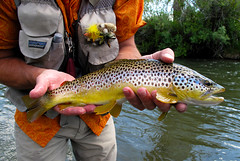
Brown trout are the proverbial "bullies" of the Ozark streams. While they are usually fewer in number than rainbows, they often take up most of the prime water, relegating the inferior water to other trout species. The trophy sized browns tend to be aggressive, more likely to strike a Rapala or a big streamer than a dainty dry fly. Smaller browns generally respond to the same techniques that produce rainbows. Brown trout tend to be more wary than other trout species, and generally require good technique. All of the Ozark tailwaters are good bets for trophy browns. The freestone streams may not hold as large of browns, but they make up for it in numbers. As a general rule, many or most browns caught from a tailwater will be wild fish, while freestone browns are always stocked.

Image of a brook trout (Salvelinus fontinalis)Image via Wikipedia


  • Brook Trout
Brook trout are often overlooked in the Ozarks. Only found in the Arkansas tailwaters (besides a small remnant population in the Spring River and several other small streams), these are probably the prettiest trout to be found in the area. They also tend to be relatively easy to catch, responding well to dry flies and nymphs, as well as spinners and spoons. Brook trout run much larger in the Ozarks than they do elsewhere, averaging between 12" and 14". Some trophy sized brooks up to 20" can be found. While all of the Arkansas tailwaters hold good populations of Brook trout, the best numbers will always be found the first 10 mile below the dam. The entire Norfork tailwater is a great bet for big brookies. There has been some reported natural spawning of brook trout, but they must be stocked to maintain fishable numbers.

  • Cutthroat Trout

YELLOWSTONE(Snake River Fine-spot?) CUTTHROAT ...Image by Fool-On-The-Hill via Flickr

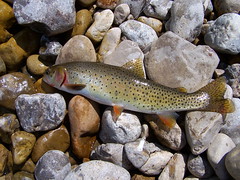
Like Brook trout, Cutthroats are for the most part found only found in the tailwaters of Arkansas, although there is also a good population found in the Spring River. They're not difficult to catch, but good populations are only found in the first 15 or 20 miles below the dams, and in the first 5 miles below Mammoth Spring on the Spring River. Nothing makes you feel like your out west more than hooking cutthroat after cutthroat on a big dry fly. And that's very possible on all of the tailwaters, as cutthroat tend to be very willing to rise to dries (even when there's not actually a hatch occurring), especially during low water. The Little Red below Greers Ferry Dam may be the best bet for those targeting cutthroat. The Norfork and Bull Shoals tailwaters are close behind. Cutthroat trout populations are maintained by stocking.

These are the most common species of trout found in the Ozarks. While other species can be found sporadically from occasional stockings (Golden trout and Lake Trout being examples), these four are the only ones your likely to catch. All of these trout have many similarities, but they are different in some very special ways.
Reblog this post [with Zemanta]

Friday, October 16, 2009

Ozark Trout Fishing Resource

Probably with poor timing and even jumping the gun a bit, we have gotten off the ground a section at Family-Outdoors devoted to Trout Fishing in the Ozarks. The area will be broken into the sections titles Trout Parks, Freestone Rivers, Tailwaters, and Smaller Streams. We believe that this will be one of the few areas on the web where such a comprehensive treatment of these areas of Missouri and Arkansas and the trout fishing opportunities available. Comprehensive descriptions of the waters and the tackle and flies that will be effective will all be a part of this section.

We hope it will be a highly used and helpful resource!

Reblog this post [with Zemanta]

10 Tips to Keep Your Outdoor Gear in Working Order and Well Organized

Camping Gear - It's expensive to buy, make it last. Maintaining and organizing your outdoor gear is crucial for ensuring it remains func...