Wednesday, March 10, 2010

Great Places to Camp In Missouri: The Irish Wilderness

In my last post on Finding Great Places to Camp in Missouri, I talked in some detail about the Eleven Point River area and referenced the Irish Wilderness.  I mentioned I would discuss in a aseparate post camping in the Irish Wilderness backcountry.  Here it is...

The Forest Service has an excellent brochure on the Irish Wilderness.  This has a lot of history as well as backcountry ethics information.  On that score, let me underscore the notion that the Irish Wilderness is managed in a fashion that in the future it will be as much of a wilderness as it is in its current state.  The "Leave No Trace" credo is the rule here.  Having said this, let me jump into a discussion of modes of travel and camping in this area.

There are two major trail systems in this 16,500 acre gem.  A map of the area is essential, even if using one of the areas trail systems.  The major trail in the area is Whites Creek Trail.  Click on this map link for a basic trail map.  It is an 18.6 mile loop trail, and is of moderate difficulty.  It is used also as an equestrian trail, but motorized and non-motorized vehicles are not allowed (mountain bikes).  There is plenty of wildlife including bears, bobcats, deer, and turkey.  There are also plenty of snakes, some venomous, as well as ticks.  Be prepared, and consider Fall or Spring visits to minimize some of these things.  This is truly a magical place as the slideshow below portrays:


Irish Wilderness-Mark Twain NF, Mo

Come prepared and click the link below for a comprehensive list of camping gear to consider bringing:
Camping Gear Checklist
Reblog this post [with Zemanta]

Tuesday, March 9, 2010

Great Places to Camp in Missouri


Missouri is blessed with many great camping locations. They are kind of segregated into the following categories:

  • State Campgrounds
  • Campgrounds on Federally Managed Land (National Park Service and National Forest Service)
  • Conservation Department Lands, and
  • Private Campgrounds.
The other way that camping areas could be grouped would be by geographic location. Because most camping in Missouri is done around the large lakes, along the Ozark rivers and Streams, and in other Ozark regions, I will concentrate my discussion on these areas. There are a number of activities to enjoy while visiting these places and I will touch on these as well. For the sake of brevity, I will split this over a number of blogs.


The first area I will take up will be the beautiful Eleven Point River and the Irish Wilderness. We have taken up the topic of Eleven Point River Trout Fishing and you can find out a lot by visiting this site. Here I will say that there are outstanding rainbow trout and smallmouth bass fishing opportunities on this river, as well as less outstanding but healthy populations of other species as well. The river is an outstanding floating stream year round with class I to class III whitewater in a couple of locations and depending on water levels.

The camping in the area is ample along the river. Let me state that camping is NOT allowed on easements which are private property and are marked in almost all cases. From the Thomasville access to the Riverton access you will truly feel that you are in a wilderness. There are few to no dwellings visible from the river. There are a number of float camps on the Eleven Point. They are primitive in that they do not have water, have vaulted toilets, are first-come (no reservation), and you are expected to pack out trash. They do have fire rings and tent sites. These camps are Denny Hollow (river mile 6.5/river left), Turner's Mill (river mile 21.5/river right), Stinking Pond Float Camp (river mile 22.0/river left), Horseshoe Bend (river mile 26.5/river left), Barn Hollow (river mile 27.0/river left), White Creek Camp (river mile 28.5/river left), Greenbriar (river mile 31.0/river left), Boze Mill (river mile 33.5/river left), and Morgan Creek (river mile 44.0/river right).

There are a couple of traditional campgrounds along the river. One is Greer Crossing Campground. There is a boat launch here and running water for drinking. There is a total of 19 sites and our experience is that the campground is very nicely maintained. It is located river right at river mile 16.7.

Floating the river is a relatively simple affair with 2 semi-challenging exceptions- Mary Decker Shoal and Halls Bay Rapid. A nice photo of Halls Bay is:
halls bay rapid. Mary Decker is at river mile 20.1 and Halls Bay is at river mile 34. They can and probably should be run on the right river line. I have found especially Mar Decker to be deceptive in that it appears a better run on the left. A review of the run from downstream will likely have you agreeing with my assessment.

There are canoe rental and shuttle services in the area. One is Eleven Point Canoe Rental and another is Richards Canoe Rental. I do not vouch for either as I have always had my own gear.

The Eleven Point is a beautiful river and the Irish Wilderness is a true gem.. Next time I will discuss some of the area's backcountry.


Reblog this post [with Zemanta]

New Ozarks Streams Trout Fishing Reports

We have added this new section for Ozarks Streams Trout Fishing Reports

Sunday, March 7, 2010

Fool's Paradise by John Gierach Blog 1

In Chapter I, "Trips", Gierach has this paragraph:

Color Plate Brook Trout from American Fishes b...Image via Wikipedia


"And then there's the fishing itself. Even if its a familiar fish in a recognizable setting, there are bound to be regional quirks. On the Namekagon River in Wisconsin the smallmouth bass were exactly where I'd expect them to be and they'd eat the same commercially tied deer-hair bugs I always try first, but they were noticeably partial to the yellow-belly version instead of the otherwise identical white-bellied ones I brought from home. Fishing is full of those minute details that actually matter."

Preceding this paragraph, the author has talked some about how the fishing is just part of the experience, but the force that drives the fisherman into that experience. Here he makes the transition into the fishing part. The last sentence of the paragraph is the one that caught my attention. Isn't that the truth? Fishing is full of those minute details that actually matter, but it often seems like there are so many, and figuring out which of them ARE the ones that matter is most of the battle.

Do you ever wonder, especially right after a battle with a big fish that has broken you off, does it really help using that delicate tippet so the fish cannot see your line? When you have changed to a new fly, do you wonder when you catch a fish right away whether it was the fly, or did you cast a bit different, or did the fish just "turn on" right at that same moment?

Of course fishing isn't the only venue where our mind goes through these gyrations. As a classroom teacher, I am constantly asking myself similar questions. Was it something I did, or was it something else. It just takes time to figure things out. Being systematic can help, but that process is tough for me. I have a feeling that many times I miss those minute yellow or white belly details.


Reblog this post [with Zemanta]

Tuesday, March 2, 2010

Opening Day Alternatives


Don't get the wrong idea about what I am saying here. I love the trout parks and I even love opening day of the trout season. You just probably won't ever find me fishing one of the opening days. I have learned the hard way to always (get the contradiction) qualify my absolutes...thus I throw in a probably before my won't. Anyway, I love the trout parks during winter catch and release season and on Summer weekdays and I love opening day because it sucks a tremendous number of the state's trout fishermen into about 5 square miles of the state's 150 miles of trout streams.

I took my son fishing in the upper stretches of the Current River on the Saturday before Monday's opening. We came in through Montauk State Park and the place was already hopping. The State Troopers had people pulled over and the campground was mostly full. We slid on through and took a look at Tan Vat and it was even a bit crowded for our liking. It was a beautiful day after all. We made our way on down to Baptist Camp, and though the parking lot had a half dozen or so cars and trucks, the fishermen were so spread out we had each hole we wanted to fish to ourselves. Though it was a warm day, the ice hung off the canyon walls creating a beautiful fishing backdrop.

We fished several hours catching and releasing a total of ten decent fish, all of which in my mind are still there awaiting our next trip. I had my required fruitless battle with what I think was a very nice brown. He is nursing a slightly sore mouth and growing to world record size as we speak. Soon, the drunken maniacs will make the river below Baptist Camp a less serene lady as she is violated by floaters who soon know not whether they are in a Scenic Riverway or the log flume at Six Flags. Then we will go somewhere else and maybe I will let you know where that is. If I am not so specific, it is because there are some smaller gems out there, but half the fun is finding them.


Reblog this post [with Zemanta]

Thursday, January 28, 2010

Trout Species of the Ozarks, by David Mann

Trout Species

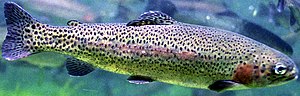
Rainbow trout are far and away the most common trout in the Ozarks. Every trout stream in the region holds at least a decent population of rainbows, and they?re the predominant species in most Ozark streams. The Missouri Department of Conservation and the Arkansas Game and Fish Commission stock literally millions of rainbows each year. Also, they reproduce well in most trout streams here. They readily take spinners, spoons, nymphs, and various dry flies. Some seem extremely gullible, and easy to catch, but there are plenty of well educated specimens that require perfect presentation, and a good deal of luck to bring to net.


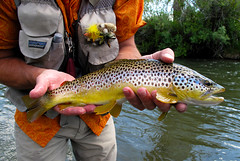
Brown trout are the proverbial "bullies" of the Ozark streams. While they are usually fewer in number than rainbows, they often take up most of the prime water, relegating the inferior water to other trout species. The trophy sized browns tend to be aggressive, more likely to strike a Rapala or a big streamer than a dainty dry fly. Smaller browns generally respond to the same techniques that produce rainbows. Brown trout tend to be more wary than other trout species, and generally require good technique. All of the Ozark tailwaters are good bets for trophy browns. The freestone streams may not hold as large of browns, but they make up for it in numbers. As a general rule, many or most browns caught from a tailwater will be wild fish, while freestone browns are always stocked.

Image of a brook trout (Salvelinus fontinalis)Image via Wikipedia


  • Brook Trout
Brook trout are often overlooked in the Ozarks. Only found in the Arkansas tailwaters (besides a small remnant population in the Spring River and several other small streams), these are probably the prettiest trout to be found in the area. They also tend to be relatively easy to catch, responding well to dry flies and nymphs, as well as spinners and spoons. Brook trout run much larger in the Ozarks than they do elsewhere, averaging between 12" and 14". Some trophy sized brooks up to 20" can be found. While all of the Arkansas tailwaters hold good populations of Brook trout, the best numbers will always be found the first 10 mile below the dam. The entire Norfork tailwater is a great bet for big brookies. There has been some reported natural spawning of brook trout, but they must be stocked to maintain fishable numbers.

  • Cutthroat Trout

YELLOWSTONE(Snake River Fine-spot?) CUTTHROAT ...Image by Fool-On-The-Hill via Flickr

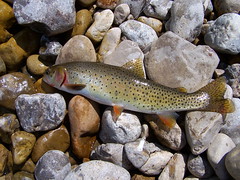
Like Brook trout, Cutthroats are for the most part found only found in the tailwaters of Arkansas, although there is also a good population found in the Spring River. They're not difficult to catch, but good populations are only found in the first 15 or 20 miles below the dams, and in the first 5 miles below Mammoth Spring on the Spring River. Nothing makes you feel like your out west more than hooking cutthroat after cutthroat on a big dry fly. And that's very possible on all of the tailwaters, as cutthroat tend to be very willing to rise to dries (even when there's not actually a hatch occurring), especially during low water. The Little Red below Greers Ferry Dam may be the best bet for those targeting cutthroat. The Norfork and Bull Shoals tailwaters are close behind. Cutthroat trout populations are maintained by stocking.

These are the most common species of trout found in the Ozarks. While other species can be found sporadically from occasional stockings (Golden trout and Lake Trout being examples), these four are the only ones your likely to catch. All of these trout have many similarities, but they are different in some very special ways.
Reblog this post [with Zemanta]

Monday, January 25, 2010

Ozark Area Trout Fishing

If you think great trout fishing can only be found in the Rocky Mountain West or the East, think again. More specifically, some of the very best trout fishing in the United States has developed in the Ozark Mountain Region of the Midwest. Nestled in an area mostly contained in Southern Missouri and Northern Arkansas, some outstanding fishing opportunities are out there for rainbow trout and brown trout, even a few spots where brook trout and cutthroat trout can be had.
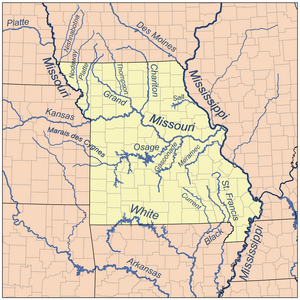
Map showing the major rivers of Missouri. Desi...Image via Wikipedia

Rainbow Trout (Oncorhynchus mykiss)Image via Wikipedia

Picture of White River near Flippin, AR, by Ja...Image via Wikipedia


Essentially, these regions can be subdivided into four categories. Thinking of the fishing opportunities in this way can help you zero in on the kind of fishing you are after. There really is, as you will see for yourself, a little bit for every kind of fisherman out there. As a bit of an aside, many of these streams and rivers also offer outstanding smallmouth bass fishing opportunities as well.

The first of these types of fisheries is the Missouri Trout Parks. There are four trout parks in Missouri, all in or bordering on the Ozark Mountain Region. These parks are managed by the Missouri Department of Conservation and are stocked for the most part with rainbow trout, but also have some brown trout as well. These parks are heavily stocked during the catch-and-keep season. During the catch-and-release season, the parks are less heavily stocked but there are still very nice populations, the fish are larger in general, and a fisherman has a bit of elbow room to him- or herself. If this is not your thing, perhaps one of the Ozark Region's tailwater fisheries might be more to your liking.

Perhaps the most famous of these is the White River below Bull Shoals Dam in Northern Arkansas. However, if maybe less famous, there are also awesome fishing opportunities on the Norfork Tailwater, the Greer Ferry Tailwater (Little Red River), as well as Lake Taneycomo. These fisheries are interspersed throughout the Missouri and Arkansas Ozarks. Popualtions and size of fish are world class in these fisheries. Browns over 20 lbs are not unheard of and until recently, the World Record Brown Trout was from the Little Red.

There are a few freestone rivers that give trout and smallmouth fishermen some outstanding waters to both float and wade fish. Perhaps the most famous of these is the Current River. It can be a bit (okay a lot!) of a party river, but this is only in the warm weather months. Additionally, for more solitude, try the Eleven Point River, barely a stone's throw away from the Current and with a small fraction the traffic. World class smallmouth fishing and some very nice rainbow fishing can be found on this river as it winds through the Irish Wilderness and then meanders down to the Arkansas border. The Meramec River and especially the North Fork of the White River should also be considered.

Finally, tucked into the rolling region can be found some smaller fishing gems that can be classified as smaller streams. With a bit of research, these streams can yield a very nice experience to the fisherman looking for wild trout fishing opportunities as well as a place to himself. These streams are beautiful and so are the fish taken (an hopefully released).

To continue researching these areas and for more specifics, go to Ozark Trout Fishing.
Reblog this post [with Zemanta]

10 Tips to Keep Your Outdoor Gear in Working Order and Well Organized

Camping Gear - It's expensive to buy, make it last. Maintaining and organizing your outdoor gear is crucial for ensuring it remains func...