Friday, May 31, 2013

A Short History of Missouri Forests

Second Article in Managing Missouri's Public Land for All
If you are like me you are predisposed to the assumption that things were better “back then.”  In the case of the forests of Missouri, it depends on which “back then” you mean.  The forests of Missouri are indeed quite different today than what one would have encountered in 1850, 1870, 1910, or 1930.  These four years are very approximate dividing lines regarding the history of Missouri forests.  Stepping across these lines one way or the other would have taken the observer into forests, or at times almost no forests, that were radically different.  


I want to be clear that I am not a historian, and one would almost certainly take some minor issues to
Shortleaf Pines near Rocky Creek in
the Ozark National Scenic Riverways.
Theses trees once dominated the Ozark
Plateau landscape.  Oak and hickory now
have taken over their dominant role after
the excessive logging between
 1870 and the 1920's.
time frames and events that I will share from my research.  Part of the problem with that is in the fact that some of the issues are not 100% agreed upon in the research that I did.


Prior to 1850, the forests of Missouri, both the sprawling forests of the Ozark highlands in southern Missouri and those of northern Missouri had not seen radical change from their natural state.  In the 1850’s, some immigration began to occur into the Ozarks, but by-and-large, the impact on the landscape was minimal.  Some trees were cleared for very small farms and the buildings for the immigrants, but the impact up to now were minimal.  The primary species of trees in the Ozark Highlands during these years and those preceding them was shortleaf pine.  


This status quo, in other words some minor impact from new settlers to the Ozarks, continued to carry the day, with some increase in logging as St. Louis and other cities utilized the forest resources up until the Civil War.  The Civil War had an immense impact on everything throughout Missouri in general, and perhaps most greatly in the Ozarks.  The Ozarks became a den of thugs throughout the war and for sometime after.  The population was decimated in the region, and there was no possibility for commercial endeavors such as logging to occur.


That all changed in a slow and steady manner beginning in about 1870.  Gradually, as rule of law began to take hold through the region, logging interests began to buy up vast tracts of the Ozarks.  Land was dirt cheap, and the resources, as is so often the case, seemed inexhaustible.  It truly was amazing how quickly this premise was proven wrong.  Timber for railroads and the construction of postwar America was in high demand.  The Ozarks essentially were an enormous logging camp until the resource was in fact exhausted.

Logging hit its peak right around 1910.  By the 1920s, there was nothing left whatsoever to log.  The shortleaf pine was essentially extirpated from the Missouri Ozarks.

As the logging companies no longer needed their land, much was put on the market.  Some of it was subsequently mined.  Other parcels were sold off at bargain prices.  With the source of income for the locals gone, they turned to farming.  Without going into great detail, the assumption by landowners was the best way to increase the quality of the soil was to burn off whatever trees and other vegetation had managed to survive the logging era.  This was not done just once, but would be done on a regular basis.  One source asserted that in some years, 50% of the landscape was put to the torch.  The truth was that the burned vegetation would provide a short term flury of growth, but made no meaningful difference in soil quality.  

That is unless you mean that it had the impact of creating enormous erosion nightmares.  The clean running Ozark streams would run as dirty as the Mississippi or Missouri Rivers.  What’s more, what little decent soil there really was across the Ozark Plateau was being quickly transported to the Gulf of Mexico.  

By the 1930’s, there began to develop a sense that the Ozarks and Missouri in general were in trouble.  At this time, two things started to turn the tide.  First, the Missouri Conservation Commission was created.  This non-political organization is an example to this day of the way common sense conservation can be executed at the state level.  Many states have tried to emulate the success of this organization, but few have matched its effectiveness. (Author’s Editorial Comment: Missouri state legislators have recently tried to politicize the operations of the MIssouri Conservation Commission as well as the Missouri Department of Conservation.  This would be tragic for hunters, fishermen, hikers, water sport enthusiasts, campers, and so on.)

The other thing that dramatically affected the forestlands of Missouri at this time was the depression era Civilian Conservation Corp (CCC).  These men planted millions of trees to replenish the depleted forests and built parks, trails, and other facilities to enhance the opportunities for visitors to enjoy this potentially beautiful region.

Also, it would be leaving out a lot to not mention that the first purchases of Federal land began to be purchased during this era.  What’s more, recognizing the poor land management practices of the local population, efforts were made by the Federal government to educate residents on the matter.  Since few areas had electricity, trucks with mobile movie projection equipment would go from settlement to settlement showing movies for people who might never have seen a motion picture on how they could better manage their land.

At this juncture, Missouri’s wildest region had few of its native trees remaining, as well as almost no wild game.  Turkey and deer numbers were wiped out across the entire state.  But a foundation was in place for a gradual improvement in all of these areas and that process had begun.

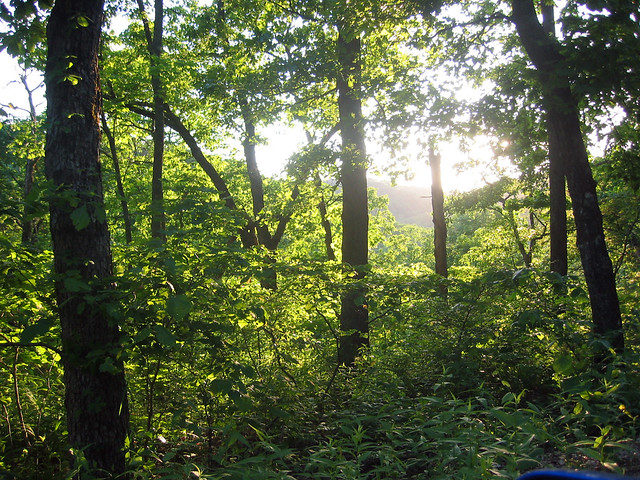
There are shortleaf pine to be found now in the Ozarks, but the forests more closely resemble those of northern Missouri in that they are predominantly oak and hickory.  The forests of the Ozarks and the state as a whole are in infinitely better shape than they were then.  Game populations are in relatively healthy shape.  But could they be better and what are the practices being employed by the United States Forest Service and the MDC?

These will be topics for our subsequent explorations.

"Forests | Missouri Department of Conservation." 2010. 31 May. 2013 <http://mdc.mo.gov/discover-nature/habitats/forests>

"CCC Strong: Historic 1930s structures in our state parks | Missouri ..." 2011. 31 May. 2013 <http://mostateparks.com/blog/state-parks-stories/58988/ccc-strong-historic-1930s-structures-our-state-parks>

Wednesday, May 29, 2013

USDA offers General and Continuous CRP sign-up

English: Logo for the 20th Anniversary of the ...

Over the past 27 years, the federal Conservation Reserve Program (CRP) under the U.S. Department of Agriculture (USDA) Farm Service Agency (FSA) has created millions of acres of upland and wetland habitat for quail, pheasants, ducks, deer, turkeys and a wide array of nongame wildlife by offering payments to farmers for taking highly erodible farmland out of production. Efforts continue with the USDA’s recent announcement of a General CRP (GCRP) signup May 20 – June 14.
USDA also announced the restart of sign-up for the Continuous CRP (CCRP) on May 13. Landowners once again have the opportunity to enroll crop field borders or whole fields in wildlife friendly vegetation. CCRP is offered on a continuous, non-competitive sign-up basis.
Landowners enrolled in GCRP and CCRP receive annual payments and cost-share assistance to establish long-term, resource-conserving covers on eligible farmland. According to the FSA website, “CRP is a voluntary program that helps agricultural producers use environmentally sensitive land for conservation benefits. Producers enrolled in CRP plant long-term, resource-conserving covers to control soil erosion, improve water and air quality and develop wildlife habitat. In return, FSA provides participants with rental payments and cost-share assistance. Contract duration is between 10 to 15 years.”
Additionally, in response to the continued loss of CRP acres and the important wildlife habitat it provides in Missouri, the Missouri Department of Conservation is continuing the MDC CRP Incentive Program in select CRP priority areas. MDC is offering landowners a one-time incentive payment of $100-$150 per acre for enrolling in the wildlife friendly CP33-Habitat Buffers for Upland Birds, CP38 – SAFE, or CP42-Pollinator Habitat practices.
The MDC CRP Incentive is available in the following counties: Adair, Andrew, Atchison, Bates, Bollinger, Buchanan, Butler, Caldwell, Cape Girardeau, Cass, Carroll, Chariton, Clark, Clay, Clinton, Dade, Daviess, DeKalb, Dunklin, Franklin, Gasconade, Gentry, Grundy, Harrison, Holt, Knox, Jackson, Johnson, Lafayette, Lawrence, Lewis, Lincoln, Linn, Livingston, Macon, Maries, Mercer, Mississippi, Monroe, Moniteau, Morgan, New Madrid, Osage, Nodaway, Pemiscot, Perry, Pike, Platte, Putnam, Randolph, Ray, Ripley, St. Charles, St. Genevieve, Schuyler, Scotland, Scott, Shelby, Stoddard, Sullivan, Vernon, Warren, and Worth.
Missouri Department of Conservation (MDC) staff can help farmers and other eligible landowners determine program eligibility, options, and seeding mixes to help sustain healthy forests, fish and wildlife. Visit www.mdc.mo.gov to find local MDC Private Land Conservationists under “Who’s My Local Contact.”
For more information on the CRP general signup and other conservation programs, contact the local USDA Service Center and speak with an FSA representative or MDC Private Land Conservationist. Visit the FSA website at www.fsa.usda.gov/crp for program details.

Tuesday, May 28, 2013

Care for Trees after this VERY Wet Spring

This article was posted a couple of weeks ago by Jim Low of the MDC.  It seems very relevant right now!

JEFFERSON CITY–If you are tired of wet feet, you have lots of company. Many trees are suffering, too. The Missouri Department of Conservation has advice for helping trees cope with wet weather.

Flooding along the Mississippi and Missouri rivers and high water on many other streams has left many trees stressed, because they breathe through their roots.

Almost all trees rely on circulation of water between roots and leaves,” says Community Forestry Coordinator Nick Kuhn. “They can’t do that as effectively when their roots are under water. Many tree species can get enough air even when the soil is saturated with water. But when water extends above ground level, transpiration stops in all but a few species.”

No transpiration, says Kuhn, means no photosynthesis. No photosynthesis forces trees to draw on nutritional reserves. The longer flooding lasts, the more starved trees become.

That’s not the only reason trees suffer during floods. Immersion in water changes the structure and chemistry of soil in ways that reduce the availability of important nutrients, including nitrogen, iron, and sulfur. Bacterial action in flooded areas can produce methane, hydrogen sulfide, and other gases that are harmful to tree roots.

“There’s a lot going on under flooded soil that you can’t see,” says Kuhn, “but trees can feel it.”

Kuhn says flooding also causes negative “life-cycle effects.” These include reduced or delayed seed germination, smothering of seedlings by sediment or organic litter, reduced root and leaf growth, shallowing of root systems, and toppling of trees due to weakened roots or soft soil. The longer the flood, the worse the damage.

The news isn’t all bad, however. Kuhn says homeowners have several options for helping flood-stressed trees recover. The first thing to do is examine trees after floodwaters recede.

“Look for exposed roots, lifting of soil caused by leaning trees, and damage from flood debris,” says Kuhn. “Removing sediment that has accumulated beneath trees will help give roots the air they need. But be careful not to damage roots in the process of removing sediment. Frugal application of a slow-release fertilizer can help trees recover, too.”

Small trees toppled during floods sometimes can be reset and saved. Pruning dead branches also helps stressed trees recover, but Kuhn cautions against “topping” trees by cutting off all but the main branches. He suggests consulting a certified arborist for advice about proper pruning techniques.

Flooding is less damaging to trees before they begin to leaf out. Trees whose root systems are undermined by erosion have a poorer chance of survival, as do those whose roots are buried beneath heavy sediment.

Stress can appear over long periods, so it is important to continue watching trees for signs of decline in the months and years after floods. Kuhn suggests taking pictures of trees immediately after flood events for future reference. “Changes can appear so gradually that you forget what the tree looked like before,” says Kuhn. “Photos can be a big help.”

When evaluating trees’ prospects for survival, it helps to know which species are most flood-tolerant. This knowledge also is critical when selecting trees to replace those lost in flood-prone areas.

The most flood-tolerant species include silver maple, honey locust, persimmon, cottonwood, willow, and cypress. Moderately resistant species include swamp white oak, mulberry, elm, hackberry, hawthorn, Osage orange, birch, sycamore, and pecan. The least tolerant tree species are oaks, hickories, sassafras, dogwoods, cherry, redbud, walnut, crabapple, spruces, and pines. Not all of these trees are good for forest, farm, or home but are listed for flood tolerance.

For more information about tree planting and care, visit www.mdc.mo.gov/node/5947.

-Jim Low-

May Meeting of Missouri Conservation Commissiom Later This Week

The Missouri Conservation Commission will meet in open session on May 31st at Van Buren beginning at 8:30 am.  An excutive session will have met the evening before but its closed to the public. 

The executive session is where things that are legally deemed to be permissable to discuss outside the view of the general public are taken up.  Some examples are matters regarding personnel, license revocations, and certain real estate discussions.

One item on the agenda of particular interest to Missouri outdoor folks will be a presentation by Jason Sumners, MDC Resource Scientist.  Jason will be discussion the status of the Missouri deer herd as well as proposed regulation changes for the upcoming year.

Another item that will be discussed is possible changes to regulations on early migratory bird seasons.  This presentation will come from Doreen Mengel, MDC Resource Scientist.

Two other planned presentations will be given by Michael Bill, MDC Resource Forester and by Jeff Cockerham, MDC Education Outreach Chief.  Michael will be discussion sustainable forest management guidelines.  Jeff will be discussing the Missouri Hunter Education program.

There will be a reccomendation to sell 1.1 million board feet of timber off of Pech Ranch Conservation Area.

Other topics include some project status summaries and the like, as well as all the license revocations for the month.

visit mdc.mo.gov for more information.

Monday, May 27, 2013

Managing Missouri's Public Land for All

View towards the Saint Francois Mountains of t...
View towards the Saint Francois Mountains of the Missouri Ozarks from the top of Knob Lick Mountain. 

In an article in the June/July 2013 issue of "Outdoor Life," called "Silent Autumn,"
the author (Frank Miniter) details on a broad scale the issue of how public forests are being managed (or mismanaged) with regard to hunting.  He calls out Missouri as one of the states that is doing a better than average job in its management practices.  So today, I thought we would begin a series of articles exploring some of the issues facing land practices in Missouri.  Some of these issues, I am well-versed in.  Others will require extensive research and discussion with foresters from the Missouri Department of Conservation, United States Forest Service, as well as hunting groups, conservation groups, and environmental groups.

In other words, we recognize that there are diverse interests in how Missouri's
public lands can and should be managed.  The question is how are the lands being managed now?  Are there specific interests that are receiving the lion's share of consideration by management agencies?  If so, is this excessive consideration for one of the groups at the expense of the needs of the others, and specifically to the needs of the environment and wildlife populations.

It has been our experience for example that though the Missouri Ozarks region is
absolutely beautiful, perhaps the management practices are not ideal for deer, turkey, quail, and other game populations.  We engage in this process with an open mind, and will report what we find. 

We would love input from our readers.  If you have a specific thought on these matters, or an area you would like us to research, please use the comment section at the bottom of the page.  

Saturday, May 25, 2013

MDC adds 39 “Plus-1” to Missouri elk restoration effort

Bull calf nicknamed “Plus-1” born on livestock trailer en route from Kentucky. 

CARTER COUNTY, MO. – The Missouri Department of Conservation
Meet newborn bull calf nicknamed Plus-1.
He was born in the trailer May 21
on the way from Kentucky to Missouri
for 2013 MDC elk restoration efforts.
(MDC) added 20 adult cow elk, 16 yearling cow elk, three yearling bull elk and one newborn male calf to its elk restoration project in the Ozarks Tuesday morning.

Transported via livestock trailer from Kentucky, where they spent the past four months quarantined in a holding pen, the elk arrived at temporary holding pens on MDC’s Peck Ranch Conservation Area at first light. MDC staff quickly ushered the hoofed cargo into spacious holding pens, and within an hour Missouri’s newest four-legged residents were resting in the shade and grazing on lush clover.

Thirty-nine elk started the journey west, which ended with 40. MDC’s Jake Rieken, who made the trip west with the elk after spending the past four months caring for them in Kentucky, got a wonderful surprise when the convoy stopped so staff could check on the animals. He discovered that one of the pregnant cows had delivered a male calf. To avoid injury to the newborn, Rieken and other MDC staff removed it through a side door in the trailer. They placed it in a large animal crate in the bed of a pickup truck, secured the blanket-covered crate, and continued the trip. The newborn calf, nicknamed “Plus-1,” was reunited with its mother in a holding pen at Peck Ranch.

“He is doing very well,” said MDC State Wildlife Veterinarian Kelly Straka.
MDC's Jake Rieken, who made the trip west with the elk
after spending the past four months caring
for them in Kentucky, holds the newborn bull calf
nicknamed Plus-1, which was born in the trailer
 on the way to Missouri. MDC State Wildlife Veterinarian
 Kelly Straka checks his heartbeat.
“He looks good and his heartbeat sounded fantastic,” she said.
“He looks good and his heartbeat sounded fantastic.”

Dr. Straka added that all of the elk underwent extensive health and disease testing in Kentucky before being brought to Missouri.

The elk will remain in the holding pens at Peck Ranch for up to several weeks as they acclimate to the area and MDC staff continue to monitor them. Some cows will begin dropping calves while in the holding pens.

“We’ve divided the pregnant cows into small groups in various pens to give them privacy and reduce their stress,” said Dr. Straka. “Those that do not calve before being released from the holding pens will seek out secluded spots to give birth. Most calves should be born by mid-June. This year’s group of 40 elk will add to the approximately 70 already living in the restoration zone. We expect several dozen new calves this spring from established elk, plus more calves from this year’s group.”

The Missouri restoration of this once-native species began with MDC bringing elk from Kentucky in May 2011 and again in May 2012 to the Department’s elk restoration zone covering 221,000 acres in parts of
These were among 40 elk from Kentucky
released into holding pens at MDC's
Peck Ranch Conservation area in May 2013.
Shannon, Carter, and Reynolds counties.

This year, MDC again worked with Kentucky and Virginia state wildlife agencies to trap elk in January from the Appalachian Mountains of southeastern Kentucky. The effort resulted in 51 elk being trapped with Missouri getting 39, plus the newborn calf. Virginia will receive the remaining elk for its restoration effort.

As done in the previous two years of trapping, Missouri-bound elk received radio collars right before their trip west as part of a research project between MDC and the University of Missouri. The collars help track movement patterns and preferred habitat. The research project is funded by Federal Aid from the Wildlife Restoration Program administered through the U.S. Fish and Wildlife Service.

The Rocky Mountain Elk Foundation helped fund the 2013 capture and care of the elk in Kentucky. RMEF also donated materials and volunteer help at both Kentucky and Missouri holding facilities.

“This restoration effort is another conservation legacy, for us and for future generations, that could not have been possible without the enormous help and support from our staff and many conservation partners including The Nature Conservancy, National Park Service, LADD Foundation and Forest Service,” said MDC Deputy Director Tom Draper.

“On behalf of MDC leadership,” Draper continued, “we continue to be impressed with the passion, talent and dedication of MDC staff, and
These were among 40 elk from Kentucky released
 into a holding pen at MDC's Peck Ranch
 Conservation area in May 2013.
thankful for their ongoing hard work on this project. We are also grateful to the states of Kentucky and Virginia for their partnerships in elk restoration. We also thank the Rocky Mountain Elk Foundation, Safari Club International, Big Game Hunters Foundation and Bass Pro Shops for their generous funding and support of this project. We are grateful to the many local landowners who have shown their support by creating elk habitat on their nearby properties, and to the communities of Eminence, Winona, Ellington and Van Buren, which have embraced the effort. We are also appreciative of The University of Missouri and the University of Kentucky for providing research support for the project.”

As in the past two years of elk restoration efforts, the 12,000-acre Refuge Area at Peck Ranch, where elk tend to congregate, is closed into July as new elk acclimate and cows give birth. MDC will open the area to elk driving tours later this summer.

For more information on elk restoration in Missouri, visit mdc.mo.gov.

Friday, May 24, 2013

MDC needs anglers’ help with bass tagging study in Ozark streams

Returning smallmouth bass tags can help Conservation Department manage this popular game fish.

WEST PLAINS, Mo. – The Missouri Department of Conservation (MDC) is asking anglers who fish select Ozark streams to help with a research project by reporting their catches of tagged smallmouth bass. One of Missouri’s most popular game fish, smallmouth bass are found predominantly in cool, clear streams and large reservoirs in the Ozarks. Bass season for Ozark streams runs from May 25 through Feb. 28, 2014.

MDC fisheries biologists are using information from the research project help manage bass habitat and harvest. This is the second and final year of the tagging effort, which involves MDC staff catching and tagging wild smallmouth bass to learn more about angler catch rates and fish movement in the Black River, Castor River, Courtois Creek, Current River and the North Fork of the White River.

Anglers are encouraged to report tagged smallmouth bass they catch in these waters. Each tag has a phone number printed on it. Anglers are asked to call the phone number listed on the tag and provide the following information: tag number, date of catch, length of bass, approximate location of the catch, and if the fish was kept or released.

“Angler participation was great during the first year and we need their continued help,” said MDC Fisheries Management Biologist Jen Girondo. “Information gained from reported catches of tagged smallmouth bass will help us manage this species, which many Missouri anglers love to pursue. Anglers don’t have to keep the fish. They may simply clip the tag and release the fish if they wish.”

Girondo said the tag return study was prompted by the need to directly measure how much harvest occurs in the Ozark streams.

“We need to ensure that our smallmouth bass fishing regulations are appropriate for providing quality fishing experiences for all Missouri stream anglers,” Girondo said. “Appropriate regulations entail that we understand where and how smallmouth use our streams and where
By: Brett Dufur
and how anglers catch smallmouth bass.”

MDC also conducted a mail survey of approximately 7,200 bass anglers from around the state in 2010 to gather their attitudes and opinions, and estimated efforts spent fishing for bass in Missouri streams. More than 4,000 anglers responded.

Results of the survey showed that anglers fished Missouri Ozark streams for smallmouth bass most often, followed by largemouth bass and rock bass. Wade/bank fishing was the most popular fishing method reported followed by float fishing. Jet boat fishing was the method least used. Most anglers reported taking multiple trips per year to fish for smallmouth bass, with 10 trips being the average. Most anglers reported catching multiple smallmouth bass per trip, with an average catch of seven per trip. Anglers also reported keeping an average of two smallmouth bass per trip. Anglers also provided more than 8,000 individual responses to what threatens the quality of Missouri stream fishing. Nearly half of all anglers responding cited pollution. For more information on the fishing survey, visit MDC online at mdc.mo.gov/node/21275 .

For more information on how MDC is working with conservation partners to manage bass habitat and harvest rates, read “Tracking River Smallmouth” in the May issue of the Missouri
By: Jim Rathert
Conservationist, available online at mdc.mo.gov/node/22005.
MDC’s smallmouth bass tagging study and fishing survey are two ways that conservation makes Missouri a great place to fish for more than one million anglers. Fishing activities in Missouri contribute more than $1.1 billion a year to the state and local economies, and support more than 10,800 jobs.

10 Tips to Keep Your Outdoor Gear in Working Order and Well Organized

Camping Gear - It's expensive to buy, make it last. Maintaining and organizing your outdoor gear is crucial for ensuring it remains func...