Friday, August 14, 2009

Trophy Bass Fishing in Missouri - Locations and Techniques

Trophy Bass Fishing in Missouri - Locations and Techniques

By Davidson Manning

While Missouri may not be known for its trophy bass fishing, there are plenty of large bass around to keep an angler busy for a lifetime. In order to catch them, you will probably have to use different techniques than you use to catch smaller bass. If you are willing to catch a few less fish in search of that wall hanger, then this article is for you. First, I will share some of my favorite big bass techniques. Then I will choose a few of the best lakes and rivers in the state to find the bass of a lifetime.
Techniques:
Live Baitfish
This is personally my favorite way to catch big largemouth bass. The setup is very simple. I use a 2/0 plastic worm hook, a split shot, and a large bobber. I hook the bait (I prefer a green sunfish between two and five inches) in the back, just under the spine. The depth I fish depends on where I am, but generally two to four feet is best. It is important to wait several seconds after the bass strikes to set the hook. When you do set the hook, do it firmly, but not excessively. Besides green sunfish, live shad, shiners, suckers, and various other minnows work very well, fished the same way.

Flipping Jigs

This is one of the best techniques for big springtime largemouth and smallmouth bass. Cast the jig into heavy cover, or near docks, let the jig sink, and jig it up and down slowly as you reel. Set the hook as soon as you feel resistance. This works well into the summer as well, but it particularly shines between March and June. My favorite jig for the method is mini-Strike King Jigs, in green and brown colors.

Plastic Worms

Plastic worms are good big bass bait from April until early November. The general rule is the bigger the bait, the bigger the bass. I prefer to Texas rig the bait, and reel in very slowly, but there are countless ways to successfully fish plastic worms, including the Carolina Rig, the Wacky Rig, and the weightless rig. My favorite big bass worm is a 7 inch Black Berkeley Power Worm. It works well for largemouth bass between two and five pounds, especially at night.

Lakes and Rivers:

Table Rock Lake
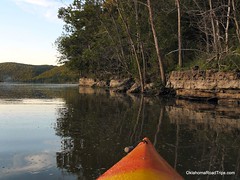
Table Rock Lake ShoreImage by FreeWine via Flickr


Most people would consider Table Rock the best trophy bass lake in the state. This approximately 40,000 acre reservoir is exceptionally clear and deep. The deep water is home to many smallmouth and spotted bass, and the shallower water holds mostly largemouth. Probably the number one trophy bass technique here is free lining three to five inch shiners. Other successful offerings are spinnerbaits, tube baits, crankbaits, and plastic worms. The main channel near the dam, the James River arm, and the Kings River arm are all great spots to find trophies, but the entire lake holds bass.

Lake of the Ozarks

This 55,000 acre lake in Central Missouri is very heavily fished, but somehow the trophy bass fishery remains one of the best in the state. Largemouth bass reign supreme here, although limited populations of smallmouth and spotted bass do exist in some river arms. The best trophy baits tend to be flipping jigs, spinnerbaits, and various plugs. The key to success here is to fish the many docks lining the lake, because the lake offers very little other cover. The Niangua Arm, Grand Glaize Arm, and the Osage River Channel are all good places to find big largemouth.

Gasconade River

The Gasconade River is a world class trophy bass river. From its humble beginnings near Springfield all the way through the town of Vienna, the river is almost entirely dominated by smallmouth bass. Between Vienna and the mouth at the Missouri River, largemouth bass take there place alongside the smallmouth. Live minnows, crankbaits, tube baits, flipping jigs, and spinnerbaits work well for both species of bass found in the river.

James River

You may have noticed in the section of this article about Table Rock Lake, I mentioned the James River arm was an excellent place to catch big bass. The fishing does not end upstream of the lake, however. All the way from upstream of Springfield downstream to where it becomes Table Rock Lake, the James River is an excellent float fishing river for huge smallmouth and spotted bass. Crankbaits, spinnerbaits, live minnows, and soft plastics are all popular.

Hopefully this article helps you learn the techniques and places to catch trophy bass here in Missouri. It may not be likely that you will catch a world record bass in Missouri, but that does not mean that fishing for them is not an exciting or heart throbbing experience.

Davidson Manning is an avid outdoorsman spending over 100 days per year pursuing his passion for fishing, many of them in the Ozarks of Missouri and Arkansas. He details many of his favorite spots on his website Family-Outdoors where he writes articles not only on fishing, but also camping and hunting. Looking for recipes for wild fish and game? Visit his recipe section at Wild Game and Fish Recipes for recipes for venison, trout, as well as most other game and fish species.

His other pursuits include many days spent in the field camping and hunting. Davidson loves to share his knowledge of the outdoors in the hope of helping others to find their own connection to the outdoors.

Article Source: http://EzineArticles.com/?expert=Davidson_Manning

http://EzineArticles.com/?Trophy-Bass-Fishing-in-Missouri---Locations-and-Techniques&id=2333576


Reblog this post [with Zemanta]

Smallmouth Fishing's Best Kept Secret - The Gasconade River of Missouri

Gasconade River

By Davidson Manning

The Gasconade River that flows through the northern Ozarks of Missouri is a fisherman's paradise in every sense of the expression. It is widely considered to be one of the nations best smallmouth bass streams. It is both a good place to catch and release twenty Bronzebacks, or specifically target lunker bass in the three to four pound range. The smallmouth fishing is best from the river's humble beginnings in Wright County until Jerome. There are a lot of big bass in this part of the river, and the overall numbers are ample.

:en:Smallmouth bass (Micropterus dolomieu). Ar...Image via Wikipedia


The entire river also holds catfish, rock bass, and bluegill. It is a great floating stream, and has many springs that flow into it that cause it to be navigable all year. The upper river is a medium sized or even small stream, but because of the streams such as the Osage Fork River, the Woods Fork River, the Big Piney River, Little Piney Creek, and Roubidoux Creek, the river is quite large by Ozark stream standards by the time it reaches the Missouri in Gasconade County.

The river is quite different below Jerome. It slowly becomes a largemouth bass river, probably the best stream largemouth fishery in the region, with five to seven pound bass relatively routine. Largemouths tend to hold in the warmer backwaters. There are also smallmouths in the lower river. They tend to stay in the main current where the water is colder and there is more oxygen. Catfish, rock bass, and bluegill can be found nearly anywhere. Because it has so many tributaries, the lower river can be silty at times, but it usually runs clear and is pretty. The Gasconade has far too many access points to begin naming them, but suffice it to say you will have no trouble finding a place to fish.

If you go to the Gasconade, you should also think of fishing the Woods Fork, Osage Fork, and Big Piney River for Smallmouth. If you want trout, hit Little Piney Creek, Mill Creek, Spring Creek, or Roubidoux Creek, all of which flow into the middle Gasconade directly or indirectly. In all, the Gasconade is well worth the trip if you like to catch smallmouth bass. If you need to get a canoe shuttle on the middle Gasconade or the Big Piney River, the Route 66 Canoe Rental can help you.

Davdison Manning is an avid outdoorsman spending over 100 days per year pursuing his passion for fishing, many of them in the Ozarks of Missouri and Arkansas. He details many of his favorite spots on his website Family-Outdoors where he has information on camping and hunting as well as fishing. Specifically, he has articles on a myriad of places and techniques. Consider reading his article Smallmouth Bass Fishing in Missouri where he provides additional tips on places and techniques for bornzebacks in the Show-Me state.

His other pursuits include many days spent in the field camping and hunting. Davidson loves to share his knowledge of the outdoors in the hope of helping others to find their own connection to the outdoors.

Article Source: http://EzineArticles.com/?expert=Davidson_Manning
http://EzineArticles.com/?Smallmouth-Fishings-Best-Kept-Secret---The-Gasconade-River-of-Missouri&id=2254306


Reblog this post [with Zemanta]

Thursday, July 30, 2009

Eleven Point River Trip: July 2009

We left our home 50 miles West of St. Louis on a Tuesday afternoon and arrived at Greer Crossing Campground that evening. The route to the area is one of the more scenic drives you can take in Missouri, taking us through the Ozark National Scenic Riverways and miles and miles of Mark Twain National Forest, as well as thousands of acres of state Conservation lands. It really hit me as to how fortunate we are in Missouri to have so many acres of public land in so beautiful and area.

We set up camp on Tuesday evening, and my two boys did a little fishing and then swimming. Let me tell you, that water was envigorating, as I found over the next few days as we made our trip. The river is fed from a steady diet of cold spring inflows, but perhaps the coolest section is there at Greer Crossing.

We got up the next morning and shuttled vehicles so that the truck would be there when we arrived at Riverton in a few days where our float would end. We got on the river mid-morning and were on our way. Our first day was full of great fishing (rainbow trout) and a mix of slow moving water, mildly entertaining riffles, and Mary Decker Rapid where one must pay attention to what he is doing if to accomplish the goal of staying dry. The advice of staying to the right was heeded and turned out to be wise. The left line of the river looks tempting at Mary Decker, but after going through an inspection upstream will make clear that it is not the way to go.

Though we planned to stay in one of the river campgrounds for the evening, we apparently missed the spot and instead found a beautiful and secluded sandbar for our camp. It was perfect.

On the topic of seclusion, I do not wish to leave the impression that one will encounter no one, but during the week as we were doing, the traffic was few and far between. Most of the time there was not another human in sight. Further, over our three days of floating we saw not one dwelling of any type.

Day two was equally beautiful, though without the excitement of a Mary Decker style rapid to provide entertainment. We again did well fishing, in this section picking up more in the way of bronzebacks (smallmouth bass). We put in this time at one of the river campgrounds. The campground was primitive (as expected). It was however, not well maintained. The pit toilets had been used as a dumpster by some very disrespectful campers and the area was kind of a mess.

As we prepared to shove off the next morning, a USFS cleaning crew arrived and explained they had been diverted to other tasks and had not been in for three weeks. Therefore, I felt the condition of the site was understandable. Based on the efficiency this crew displayed in their work cleaning up, I can say that they were a hard working bunch and took pride in their efforts.

Our final day was the only one in which we had so much as a sprinkle. The only real dampening effect this rain had was on the air temperature and actually was much appreciated. On our final day we went through Halls Bay Rapid, which was a lot of fun. The john boat my youngest son and I were in was heavily laden and hung up on one of the boulders in this ledge style rapid.

We stayed upright, but he volunteered to disenbark which allowed the boat to float free down the rest of the rapid.

We took out at Riverton and headed back to Alton, Missouri and enjoyed a great meal as there are several decent places to eat as well as good grocery stores, etc. All-in-all, this trip was all and more we had hoped for. We grew as a family as we worked together and enjoyed some of the most beautiful scenery the state has to offer, not to mention some great fishing!

Read more at Family-Outdoors Fishing.


Reblog this post [with Zemanta]

Saturday, July 4, 2009

Upcoming Float Trip and Another Contraption


Here in a few days, we are headed on a float trip to one of Missouri's less traveled streams...so I am not talking about the Meramec or Current Rivers. There will be a party of five in a 12 foot jon boat and a 14' canoe. We are also bringing an inflatable kayak. That's about all the details I will give right now about the actual trip logistics, but I'll report all the happenings after we return.

What I will say is that I built a pretty cool rack to carry our canoe and jon boat down to the river. Since I cannot weld and am way too cheap to buy a ready made rack, it is built from wood. I will include some pics after our trip is over. I constantly am given grief by my wife and kids about the hoosier contraptions I build for these types of trips.

Several years ago, we took a trip to Montana, Wyoming, and a few other places out West. I built the most outrageous contraption to stow out gear in my crew cab Chevy S-10. My kids would not be seen in it in our home town, but admitted after the trip it was pretty cool.
Reblog this post [with Zemanta]

Friday, July 3, 2009

Missouri Wildlife Code Changes

Several days ago, I wrote about a couple of reminders pertaining to hunting permits (youth permit changes and managed hunt applications). I thought I probably ought to mention that there were quite a few other changes as well.

There are changes in antler-point restrictions, urban deer hunt areas, and quite a few others. An article summarizing some of the changes can be found at Wildlife Code changes take effect July 1, and the agencies website can be found at MDC. It might be advisable to take a look and avoid any surprises that might negatively affect your outdoor plans
Reblog this post [with Zemanta]

Thursday, July 2, 2009

So You Think You Caught a Record Fish?

If you catch what you think is a state record fish it will be an easy matter to prove it, right?

Not so fast...

The MDC has a set of criteria that must be met for this to happen. If you think there's a chance you will ever catch a record fish and try to get it in the state record books, you might want to know this stuff now...it'll kind of dictate what you do after catching your monster fish.

There are 7 criteria listed on the State Record Form published by the MDC. Most are pretty straight forward, like you have to have caught the fish in Missouri waters. The one that I think you should know up front is that the fish will have to be weighed on certified scales in the presence of a Conservation Agent. That means that after you have made your catch you will have to be able to get to a certified scale AND get a Conservation Agent there before the fish goes below the record weight. If you didn't know this, fish begin to lose weight after they are caught.

It is clear, at least it seems that way to me, that all the rules serve a vital purpose, but not knowing them ahead of time could result in not getting a deserving fish listed.

Wednesday, July 1, 2009

10 Tips to Keep Your Outdoor Gear in Working Order and Well Organized

Camping Gear - It's expensive to buy, make it last. Maintaining and organizing your outdoor gear is crucial for ensuring it remains func...