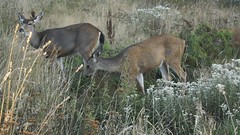
Wednesday, November 2, 2011

Quail Forecast has bright spots

Virginia WAchtelImage via Wikipedia
Population surveys on Quail Emphasis Areas and private land
present a different picture than those for the state as a whole.
JEFFERSON CITY–Results of Missouri’s annual statewide quail population survey give quail hunters little to rejoice about. However, bobwhites are holding their own in some areas and making gains in others where landowners and the Missouri Department of Conservation (MDC) have made quail management a priority.
One way the agency tracks quail is through roadside surveys. Each August, conservation agents count quail along 30-mile routes in 110 of Missouri’s 114 counties. Only Clay, Jackson, St. Louis and St. Charles counties are not surveyed. The 2011 roadside surveys recorded an average of 1.4 quail per 30-mile route. That is 36 percent lower than last year and 56 percent below the average over the past 10 years. Results from the roadside survey are consistent with other measures that document a continuing, long-term decline in bobwhite numbers statewide and throughout most of their range.
Agricultural Wildlife Ecologist Beth Emmerich, who analyzes bobwhite quail population data gathered by MDC field staff, says that while Missouri’s quail picture is not rosy, it isn’t as bad as the roadside survey numbers make it seem. Shenotes that quail populations vary significantly in different parts of the state and even locally. Some of those variations reflect differences in weather patterns. Others show where MDC and private conservationists have been at work.
“Quail counts in northwest Missouri are up 63-percent compared to last year,” said Emmerich, “while counts in the Mississippi lowlands, which had severe and extended flooding this year, show a 92-percent decline over the same period. Looking at the roadside survey numbers, you might think it wasn’t worth getting your dog out of its pen, but that is absolutely not true.”
Emmerich said roadside quail surveys occur on the same routes every year. They document quail population changes in those areas over time. However, they don’t take into account quail population trends in areas where work is underway to create quality quail habitat. That is why MDC conducts fall covey counts at 19 conservation areas (CAs) that have been designated Quail Emphasis Areas.
Starting in mid-October each fall, MDC biologists visit randomly selected plots on Quail Emphasis Areas early in the morning and listen for calling quail. They record the location of each covey in earshot. They flush some of the coveys to get an idea of how many birds are in each. Feeding these data into statistical population models allows biologists to estimate area quail populations. Covey counts are a practical way to evaluate the effectiveness of habitat management efforts.
Emmerich said results from this year’s covey counts are not all in yet, and she won’t finish analyzing those data until next year. But early results already document some quail-management success stories. They also illustrate how weather affects quail populations. 
On Oct. 11, Resource Assistant Chez Kleeman flushed a covey of quail at Bois D’Arc CA in Greene County. Some of the birds were sparrow-sized and barely able to fly. Quail that successfully raise early clutches sometimes nest again and raise a second brood that year. Seeing small birds in October indicates Bois D’Arc’s quail may have “double-clutched.” Backing this up are reports from Bois D’Arc staff that quail numbers are up this year.
According to Private Land Conservationist Mike Gaskins, landowners in Dent and Shannon counties also have reported are seeing late-hatched quail and turkey broods in recent weeks.
Resource Forester Phil Sneed, who manages Poosey CA in Livingston County, also reported seeing very young quail in some covey counts, so portions of northern Missouri have experienced late quail nesting success as well.
Sneed also reported hearing coveys in new locations. That is a sign of good habitat conditions. Average covey size on Poosey was 11 to 12 quail, with two 20-bird coveys.
Dave Hoover, manager of the Seat CA in Worth County, reported covey counts slightly better than the last year. However, he cautions that quail numbers remain low there, due to extremely difficult weather conditions that plagued ground-nesting birds from 2007 through 2010. 
Staff at Whetstone Creek CA in Callaway County and William White Memorial CA in Lincoln County reported covey counts 50 percent smaller than in 2010.  Heavy snow that lingered throughout much of last winter in parts of central Missouri may have cut into this and some other local populations.
Private Land Conservationist Nathan Mechlin called 2011 a good quail-production year for Clinton, Caldwell and Daviess counties. He said both quail and turkey brood sightings are up from previous years. Those results are spotty, however, and landowners in some areas report seeing very few birds.
Each year, MDC makes habitat improvements on more than 75,000 acres on CAs. These improvements benefit quail and other wildlife that share the bobwhite’s habitat needs. Roadside quail counts occur along routes established before this work began and are not designed to measure the success of quail management on CAs.
Just as the roadside survey fails to capture information about Quail Emphasis Areas, it also does not reflect progress made on private land. Emmerich said hundreds of Missourians are working to restore quail habitat. Some have organized cooperatives to work with MDC and other agencies in dozens of Quail Focus Areas around the state.
“The Conservation Department is making a significant investment in quail management on private land each year through cost-share and landowner incentive programs,” said Emmerich.  “One partnership we are especially proud of is the Habitat Challenge Grants program. This summer, the Department awarded a total of $133,000 in funding to Quail Forever, the Quail  and Upland Wildlife Federation, Quail Unlimited and the National Wild Turkey Federation. Through habitat challenge grants, each of these conservation organizations provides matching funds to help landowners complete habitat work on their land.”
Emmerich said MDC’s Landowner Assistance Program channels more than $1 million a year into habitat enhancements that benefit quail and other wildlife that share the bobwhite’s habitat needs. The agency also promotes federal farm bill programs such as the Conservation Reserve Program, which funds quail-friendly habitat work.
For locations and additional information about MDC’s Quail Emphasis Areas, visit mdc.mo.gov/node/3333. For more information about Quail Opportunity Areas and quail management, visit mdc.mo.gov/node/12606.

Tuesday, November 1, 2011

Deer hunters reminded of changed permit format, tagging procedures

DeerImage by gibsonsgolfer via Flickr
A new YouTube video shows how to “bag it,
notch it, tag it and check it.” Free permit protectors
are available from conservation agents and MDC offices.
JEFFERSON CITY–With the November firearms deer season on the horizon, the Missouri Department of Conservation (MDC) reminds hunters of changes to deer and turkey permits and tagging procedures that went into effect in this year.
The November firearms deer hunt starts Nov. 12. The 11-day season typically accounts for approximately 80 percent of the firearms deer harvest each year.
This year is the first time that Missouri hunters can buy deer and other hunting permits online, print them and use them immediately. Hunters can use this new e-Permits system to buy permits online or purchase them in person at MDC regional offices, nature centers and other offices statewide. Hunters also still can buy permits from hundreds of vendors statewide.
Vendors still are printing permits on the familiar yellow plastic material that has been used in the past. However, the format has changed and no longer includes a separate self-adhesive tag. Within a couple of years, all permits will be issued on plain paper.
The new format does not include separate tags for deer or turkeys as in the past. Under this new e-Permits format, deer and turkey permits are permit-and-tag in one.
With these changes come some changes in deer and turkey tagging and checking procedures. These are explained in the 2011 Fall Deer and Turkey Hunting Regulations and Information booklet, which is available wherever permits are sold or at mdc.mo.gov/node/3656. MDC also has a Web page (mdc.mo.gov/node/3891) explaining the procedure. It even has a short video at youtube.com/watch?v=CHFp_9UiKjg that illustrates the reminder phrase, “Bag it, notch it, tag it, check it.”
“E-Permits offer some significant advantages in terms of convenience,” said MDC Permit Services Supervisor Greg Jones. “We know that changes can be confusing. We want to be sure hunters have easy access to permits and information about the new procedures in whatever form they like best – in person, in print, online text or video. If folks still have questions, they can call or visit any of our offices for help.”
MDC is providing free permit protectors through its conservation agents and regional offices.
-Jim Low-

Monday, October 31, 2011

Deer hunters need to be bear aware

Louisiana Black BearImage via Wikipedia
Cover scents used by deer hunters and other intriguing smells can
overcome bears’ natural shyness and bring them too close for comfort.

SEYMOUR, Mo.—Daron Wilkins wasn’t looking for a close encounter with a black bear when he climbed into a tree stand on Nov. 2, 2010, but he got one. Good luck allowed him and the bear to escape unharmed, but the Missouri Department of Conservation (MDC) says hunters don’t have to rely on fate to determine the outcome of bear encounters.

Wilkins was hunting on private land, sitting in a 20-foot ladder stand near the edge of a field. The oak flats surrounding the field had patches of dense underbrush and blackberry thickets. He first spied the bear around 5 p.m.

“She came out of the woods about 75 yards to my right,” Wilkins recalls. “She went back in the woods after a minute or so, and I kind of assumed she had winded me and had gone away. Probably 20 minutes later she came back out in the field.”

Wilkins, who hosts the Wild Idea Outdoors show on 98.7 FM, a sports talk-radio station in Springfield, carries a hand-held video camera when he hunts, so he started filming the bear.

“She was just browsing around in front of me. Every once in a while she would stop and dig around and then move on. Over the next few minutes she browsed her way to within 30 yards of my tree stand. All of a sudden she paused and stuck her nose in the air and turned right toward me.”

Following an intriguing scent, the bear moved without hesitation to the base of the tree where Wilkins sat.

“I had no idea how fast a bear can climb. Before I knew it, she was at my feet. I don’t think she had any idea I was in the tree. She got to the foot part of my stand, where she couldn’t go any further. Then she went around to the back side of the tree and continued coming up.”

Up until that moment, Wilkins had felt nothing but excitement at seeing a bear close-up. When he found himself within an arm’s length of the animal, another emotion washed over him.

“I was actually still trying to film her at the time. I leaned over the back side of the tree, and about then a light bulb went off in my head. ‘Are you going to let this thing climb up in the tree stand with you? You better get rid of it.’”

What Wilkins did next probably wasn’t the best thing, but it worked.

“I didn’t know what to do, so I just leaned over at her and went “Naaaah!” like a doe bleating. She stopped and looked at me. At this point, she was about two feet below me. We were looking eye-to-eye at one another. I figured it was going to be flight or fight. I’m either going to startle her to the point where she takes a swipe at me, or she’s going to leave. Thankfully, she decided to leave.”

The bear backed down the tree and departed, leaving Wilkins shaken.

“I realized the danger I had been in. My hands were shaking from sheer adrenalin. It was probably 15 or 20 minutes before I calmed down enough to hold my video camera steady and speak clearly enough to describe what had just happened.”

Video of the bear’s approach and Wilkins’ reaction is available atyoutube.com/watch?v=Q0KI8dhLd8w. After viewing the video and discussing the incident with Wilkins, MDC Resource Scientist Jeff Beringer identified several themes that reoccur in many hunter-bear encounters throughout the eastern United States.

One is the fact that Wilkins was using a deer attractant scent based on doe urine. Another is that he was wearing camouflage clothing. And the bear was young, probably two years old. In spite of its keen sense of smell, it didn’t seem to notice Wilkins’ scent. It retreated as soon as it became aware of Wilkins’ presence.

“Encounters like this one aren’t what I would call common in Missouri yet,” said Beringer, “but they are going to become more common as our bear population grows. We had another, very similar event in the past week over by Ellington. Biologists in states where they have well-established bear populations tell me this sort of thing is not uncommon there.”

Beringer said black bears rely primarily on their sense of smell to find food. They are totally focused on food at this time of year and forage practically nonstop. Although acorns make up the bulk of their autumn diet, they will investigate anything that smells interesting.

Other factors likely were at work in the recent encounters as well. Bears are at the top of the food chain and don’t expect to encounter danger in the woods. Hunters begin visiting areas that bears have had to themselves throughout the summer. Young bears that have little or no experience with humans don’t always flee at the first hint of human presence as older bears generally do.

“You’ve got a hunter who is basically invisible and smells like a deer,” said Beringer. “All a young bear is thinking about is food, unless something flips the switch in its brain that says, ‘Danger!’ It’s up to hunters to flip that switch before things get out of hand.”

Looking back on his brush with the bear, Wilkins says he would do things differently the second time around.

“That bear moved so fast, the only chance I had to stop her was when she was in the field foraging. When she smelled something, her behavior went from one thing to something completely different. In a matter of seconds, I went from ‘Hey, this is cool’ to ‘She’s in the tree with me!” If I had it to do over, I would yell at her when she was still way out in the field.”

Shouting is a good idea, according to Beringer. So is waving your arms, banging on the metal of your tree stand or making other loud noises. He advises hunters to remain standing during a bear encounter so they look as large as possible, and make and maintain eye contact with the bear.

“Staring at another animal is aggressive, predatory behavior,” said Beringer. “You want a bear to know you are there, and you want it to see you as a threat.”

Beringer said advice about how to act during a bear encounter is different if you surprise a bear at close range. Hunters or hikers who suddenly come upon a bear with food or cubs or where the bear has no place to run should speak in a calm voice and back away slowly. Never run from a bear, he says. That is prey behavior.

The great majority of Missouri’s bears live south of Interstate 44. MDC studies have identified hubs of bear activity around Webster, Howell and Shannon counties. Bear numbers drop off sharply where the typical, wooded Ozarks landscape gives way to prairie in southwestern Missouri and to the intensively farmed landscape of extreme southeastern Missouri.

Availability of seasonal foods, such as berries and nuts can draw bears to those food sources, making their behavior somewhat predictable. Persimmon trees, crop fields and food plots also can be bear attractors. In years when acorns are abundant, however, bears can be almost anywhere.

Beringer said bears have good memories, and they return periodically to places where they have found food in the past. He said hunters who use corn feeders to attract deer to their property have a better chance of encountering a bear, even if they stop feeding before the hunting season, as required by Missouri’s Wildlife Code.

Beringer said bears leave ample evidence of their presence in an area, especially this time of year. Consuming large amounts of acorns results in large piles of droppings – too large to be from anything smaller than a bear. If you find a large pile of dung that contains partially digested acorns, berries and other plant material, you can be fairly sure a bear has been there.

One thing hunters can do to minimize the likelihood of a bear approaching them is to keep any food they bring to the field in sealable plastic bags. Put left-over fruit peelings, apple cores, candy bar wrappers and other refuse back in the plastic bag to reduce enticing smells.

Beringer emphasized that bear encounters don’t have to be a bad thing.

“It’s kind of cool to see a bear,” he said, “and if you’re hunting, you don’t want to ruin your hunt by yelling. I can see where a person might be reluctant to make a bunch of commotion. But when a bear gets within 30 yards, that’s time to scare it off. Stand up and wave your arms. If the bear doesn’t see you and leave, you should shout and maybe throw things at it. If a bear gets uncomfortably close, it’s OK to shoot over it.”

One scenario that has occurred in other states, but not in Missouri as far as Beringer knows, is when a bear finds and claims a hunter-killed deer. Black bears can be very protective of a food bonanza the size of a deer carcass. Beringer said a hunter should not try to force the issue if a bear doesn’t immediately flee when approached.

“Bears are protected under the Wildlife Code,” he said. “It is not OK to shoot a bear that isn’t attacking you, and it isn’t smart to pressure a defensive bear. It’s better just to leave and come back later for the antlers, if it’s a buck.”

He said hunters who are concerned about bear encounters can carry pepper spray made especially for this purpose. He said however, that black bears – unlike grizzly bears–almost never attack people. Just because a bear moves toward you doesn’t mean it is aggressive. In most cases, it is merely curious and not aware that it is approaching a human.

Myron Means is the bear program coordinator for the Game and Fish Commission in Arkansas, which has had black bears since the 1950s. He said Arkansas has never recorded a bear attack on a hunter.

“Black bears that are involved in human attacks almost always are starving or in bad health,” said Beringer. “Our bears are healthy.”

In the extremely unlikely event that a bear does attack, Beringer says a hunter should shoot it. “We’re not trying to protect those kinds of animals,” he said.

If shooting isn’t an option, Beringer said you should always fight back, kicking or clubbing with a bow, a stick or any object at hand. He said learning to live with bears is mostly a question of raising outdoors people’s awareness.

“Folks in states that have had black bears for many years don’t think much about it,” he said. “They aren’t scared of bears, because problems are so rare. People know bears are out there, and they know what to do if they see one.”

For more about black bears in Missouri, seemdc.mo.gov/node/3506.

-Jim Low-

Learn campfire cooking Nov. 5 at Dr. Edmund A. Babler Memorial State Park

Small type of campfire, good for cookingImage via Wikipedia
JEFFERSON CITYMo., OCT. 21, 2011 -- Campfire cooking can be one of the joys of being outdoors and you can learn this skill at a special program Nov. 5 at Dr. Edmund A. Babler Memorial State Park in Wildwood. The free program will be held from 2 to 3 p.m. in the campground amphitheater and the public is invited to attend.
            Campfire cooking doesn’t have to mean just hotdogs on sticks and s'mores. Learn the skill of Dutch oven cooking to make stews and other treats.
            For food preparation purposes, this program will require advance registration.  Contact the park's visitor center at 636-458-3813 to reserve your spot.
Dr. Edmund A. Babler Memorial State Park is located 20 miles west of St. Louis on Highway BA, between U.S. 40 and Highway 100. For more information, call the park or call the Missouri Department of Natural Resources toll free at 800-334-6946 (voice) or 800 379-2419(Telecommunications Device for the Deaf). For more information about state parks and historic sites, visit mostateparks.com. 

Sunday, October 30, 2011

Enjoy hunting? Then share the fun with someone new

Ray Schoenke hunting pictureImage via Wikipedia
When Minnesota’s firearms deer hunting season opens Saturday, Nov. 5, many people who would like to hunt won’t.
Why?

No one invited them.

“A lot of men, women and children will be sitting on a couch instead of a stand because no one has offered to take them hunting,” said Jenifer Wical, a Minnesota Department of Natural Resources (DNR) customer relations manager. “This year, we’re encouraging hunters to invite a buddy to camp because it is not always about the buck, it’s about friends, family and making memories that last a lifetime.”

Years ago, it was more difficult to introduce someone new to hunting because of certain firearms safety requirements. Today, firearms safety is still required for those born after Dec. 31, 1979, but Minnesota offers a two-year exemption when certain safety precautions are followed. As a result, it’s easier to introduce someone new to hunting, even on the spur of the moment.

“Many deer camps are changing,” said Wical. “Older hunters are dropping out. Younger hunters aren’t filling the void. That means there’s an opportunity to pass the hunting tradition onto someone new, someone who has been sitting on the sidelines but would have been a player if only they had been asked.”

People who want to hunt but have not completed a firearms safety course can use the Apprentice Hunter Validation Program. Under this program, adults and youth age 12 or older purchase a $3.50 validation and the appropriate hunting license. Together, these purchases enable the person to hunt when accompanied by a licensed adult hunter who is within unaided sight and speaking distance at all times.

Since this program began in 2007, roughly 14,000 people have purchased the apprentice hunter validation, according to Wical. Nearly 40 percent of these people went on to complete firearms safety courses and 30 percent are still hunting today. Those statistics, she said, suggest that many people “buddied-up to hunt” and are still doing it, which is good for both hunting and social traditions.

The apprentice hunter validation is available anywhere DNR licenses are sold, which includes by phone at 888-665-4236 or online.

MDC needs hunter help with CWD sampling of harvested deer

Distribution of Chronic Wasting Disease in the...Image via Wikipedia
Conservation Department asks deer hunters to allow MDC to collect tissue samples from deer harvested in north-central Missouri area for chronic-wasting-disease testing.


JEFFERSON CITY Mo – As part of its ongoing efforts to monitor Missouri’s free-ranging deer for chronic wasting disease (CWD), the Missouri Department of Conservation (MDC) is asking hunters for help.

MDC encourages hunters who harvest adult deer in Linn, Macon and parts of Adair, Chariton, Randolph and Sullivan counties during the early youth portion (Nov. 5-6) and first two weekends of the November firearms portion (Nov. 12-13 and Nov. 19-20) to take their deer to the following processors and roadside collection sites for tissue sampling during the following dates.

CHARITON COUNTY
  • · Salisbury Meat Market & Processing, 29047 Market Lane in Salisbury (Nov. 12-13)

LINN COUNTY
  • King’s Processing & Catering, 33181 Hwy WW in Marceline(Nov. 5-6, 12-13 and 19-20) 
  • Purdin Processing, 100 C St. in Purdin (Nov. 12-13 and 19-20)
  • Sprague’s Locker, 700 Brookfield Ave. in Brookfield (Nov 12-13)
  • Roadside Collection: Junction of Hwy 129 and Hwy 36 in Bucklin(8 a.m. – 5 p.m. Nov. 12-13 and 19-20)
  • Roadside Collection: Junction of Hwy 11 and Hwy 129 in New Boston (8 a.m. – 5 p.m. Nov. 12-13 and 19-20)
MACON COUNTY
  • Special D Meats, 30637 Lake St. in Macon (Nov. 5-6, 12-13 and 19-20) 
  • Buck Ridge Butcher Shop, 11245 Grouse Ave. in La Plata(Nov. 12 and 19)
  • Roadside Collection: Junction of Hwy 149 and Hwy Z in New Cambria (8 a.m. – 5 p.m. Nov. 12-13 and 19-20)
  • Roadside Collection: Junction of Hwy 149 and Hwy J in Goldsberry (8 a.m. – 5 p.m. Nov. 12-13 and 19-20)
SULLIVAN COUNTY

  • · Tucker’s Grocers & Processing, 355 W. Front St. in Green Castle (Nov 12-13)
“The process of collecting tissue samples will take only a few minutes and involves removing lymph nodes from the head,” said MDC Deer Biologist Jason Sumners. “The tissue sampling will not reduce the food value of deer. For those who harvest adult bucks and are worried about the taxidermy value of their mount, we are also working with many area taxidermists to collect tissue samples from adult bucks for CWD testing.”
Sumners added that hunters throughout the state who encounter or harvest deer in poor condition with no obvious injuries should contact their local conservation agent or MDC office. If appropriate, the deer will be tested for CWD.

He noted that the more than 500,000 Missouri deer hunters are vital partners in keeping the state’s deer herd healthy, along with the supporting the state economy.

“Adult deer have no widespread natural predators in Missouri so hunting is the primary way to control the population,” Sumners said. “Deer hunters spend more than $750 million directly related to deer hunting each year. This adds up to over $1 billion in overall business activity and supports more than 11,000 jobs.”

The voluntary hunter-harvested deer sampling effort is part of MDC’s response to a recent case of CWD found in a captive white-tailed deer. It is the second of only two confirmed cases of CWD with both found in captive white-tailed deer at two separate private, captive hunting preserves in Linn and Macon counties. The facility where the first case was reported in February 2010 has been depopulated.
The second case was identified by the Missouri Department of Agriculture (MDA) in October 2011 as a result of increased surveillance required by the management plan implemented from the previous CWD incident. The Missouri Departments of Agriculture and Conservation, in cooperation with the U.S. Department of Agriculture (USDA), continue their investigation of the incident.

CWD is a neurological disease that attacks the nervous systems of cervids, such as deer and elk, along with non-native cervids such as moose, red deer, fallow deer and sika deer. Cervids with clinical signs of CWD show changes in natural behavior and can exhibit extreme weight loss, excessive salivation, stumbling and tremors. CWD is thought to always be fatal to the infected animal, but it can take months or years before the symptoms of infection appear. CWD can spread through the natural movements of infected free-roaming cervids, the transportation of live captive cervids with CWD or the transportation of infected carcasses. CWD in deer can only be confirmed by laboratory examination of the brain stem or lymph tissue.

The Missouri Department of Health and Senior Services (MDHSS) stated there is no evidence CWD can infect people. The MDA stated that current research shows there is no evidence CWD can spread to domestic livestock, such as sheep or cattle.

While CWD is new to Missouri, the MDC and MDA have been testing for it for years. The agencies formed a state Cervid Health Committee in 2002 to address the threat of CWD to Missouri. This task force is composed of conservation agents, veterinarians and animal health officers from MDC, MDA, MDHSS and the USDA.

With the help of hunters, the MDC has tested more than 31,000 free-ranging deer for CWD from all parts of the state since 2002 with no cases found.

Sumners noted that Missouri residents who hunt deer, elk or moose in other states should be aware of regulations regarding chronic wasting disease. The Missouri Wildlife Code requires that hunters who bring deer, elk or moose into Missouri with heads or spinal columns attached to report the carcasses’ entry by calling 1-877-853-5665 within 24 hours of entering the state. If heads or spinal cords are intact on the animals, hunters cannot process the meat or trophy mounts themselves and must take the carcasses to a licensed meat processor or taxidermist within 72 hours of entry. Meat processors and taxidermists are required to dispose of spinal cords and other parts in a properly permitted landfill. Hunters do not need to report if they simply bring back meat, hides, antlers, teeth, skulls or skull plates with no brain tissue attached.

For more information, refer to page 9 of the “2011 Fall Deer & Turkey Hunting Regulations and Information” booklet. The booklet is available where permits are sold, including MDC offices, and online at www.mdc.mo.gov.

Fish and Wildlife Service Releases Blueprint for the National Wildlife Refuge System

Ideas for the National Wildlife Refuge System ...Image via Wikipedia

The U.S. Fish and Wildlife Service today made public a renewed vision for
the growth and management of the National Wildlife Refuge System. The
document, initially drafted by the Service and the National Wildlife
Refuge Association, articulates a 10-year blueprint for the Refuge System.


Entitled Conserving the Future: Wildlife Refuges and the Next Generation,
the Service’s vision was developed with extensive input from stakeholders
through a transparent public process during the last 18 months. The final
version of the document is now available online at
www.americaswildlife.org.

“For more than 100 years, the National Wildlife Refuge System has
conserved America’s great wildlife heritage and working lands for current
and future generations, and this blueprint will ensure that a new era of
conservation – one rooted in strong partnerships with the community –
remains vibrant for the next 100 years,” said Secretary of the Interior
Ken Salazar. “I applaud the Fish and Wildlife Service for their commitment
to increasing the public’s access to open spaces and to inspiring a new
generation to enjoy America’s great outdoors and get involved in
conserving our nation’s wild things and wild places.”

Conserving the Future underscores the importance of building and expanding
partnerships – working together with other federal agencies, states,
tribes, conservation organizations and citizens.

“The conservation challenges of the 21st century demand that the Service
renews its commitment to our important relationship with state fish and
wildlife agencies and with traditional partners such as anglers and
hunters,” said Dan Ashe, Director of the Fish and Wildlife Service. “At
the same time, we need to be creative and bold in forging new
partnerships.”

Among the vision’s recommendations, the Refuge System will:
launch an urban refuge initiative to increase the American
people’s connection with their natural heritage, including wildlife
refuges;
work with state fish and wildlife agencies to prepare a strategy
for increasing quality hunting and fishing opportunities – especially for
youth and people with disabilities – on wildlife refuges;
collaborate more with private and regional groups to conserve
wildlife habitat;
undertake an inventory and monitoring of the Refuge System’s land
and water resources to better protect them against future threats;
develop a plan to guide refuges in assessing potential climate
change impacts to refuge habitats and species; and
plan for strategic growth by prioritizing potential acquisition
sites and assessing the status of current habitat protection efforts.

To date, three implementation teams are focusing on 1) strategic growth of
the Refuge System; 2) an urban wildlife refuge initiative; and 3)
leadership development, and six more teams are being formed to focus on
aspects of the vision.

In describing the Refuge System’s role in addressing America’s
conservation challenges, the vision document states: “Human demands on the
environment combined with environmental stressors are creating an urgent
need for conservation choices. The scale of issues and challenges we face
is unprecedented and impacts us all; no single entity has the resources
necessary to address these challenges on its own. Conserving the Future
acknowledges that strategic, collaborative, science-based landscape
conservation -- along with effective public outreach, education and
environmental awareness -- is the only path forward to conserve America's
wildlife and wild places.”

10 Tips to Keep Your Outdoor Gear in Working Order and Well Organized

Camping Gear - It's expensive to buy, make it last. Maintaining and organizing your outdoor gear is crucial for ensuring it remains func...